

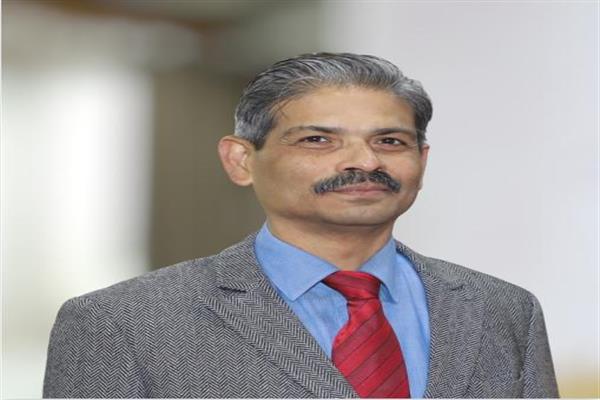
Ex-police chief says, change of policy gear need if the hour, calls for accountability to prevent repeat of past mistakes
Nadeem Nadu
Srinagar, Jan 21 :
Former Director General of Police (DGP) of Jammu and Kashmir, R.R. Swain, has said that political pressure and flawed policy frameworks created a system in which political survival in the region became linked to appealing to an anti-India separatist constituency, instead of competing on governance.
Speaking to news agency Kashmir News Corner (KNC) on the backdrop of his interview with news local news channel, Swain said the issue must be approached as a systemic and policy-level problem, not by targeting individuals.
“This needs to be approached as a systemic issue. It is not about individuals, but about the policy framework and the method adopted. These remarks are reflective and analytical, focused on the system and policy,” Swain said.
He raised serious questions over the continuation of failed approaches. “If a particular path or policy has already proven that it does not work and delivers a fixed negative outcome, then how can it be adopted again? This question naturally arises,” he said.
Swain explained that a policy-driven system created unhealthy political competition. “A system was put in place that generated competition and compelled all political parties to believe that they could survive only by appealing to an anti-India separatist constituency,” he said.
Highlighting the consequences, Swain noted that political competition shifted away from governance. “We adopted a policy under which all political parties were forced into competition not for governance but to outdo each other in using anti-India rhetoric to secure votes,” he observed.
He termed this the biggest flaw in policy design. “There is no evidence anywhere in the rest of the country that political survival depends on being anti-India. Yet, in this system, pressure was created where parties felt compelled to adopt such positions to survive politically,” Swain said.
He added that the interview underscored the urgent need to change policy direction. “The real issue is to change the gear of the policy and reassess what has not worked. If tomorrow someone becomes Chief Minister and the rules of the game dictate that survival depends on sounding anti-India in some form, then this rule applies to everyone. As a result, people act competitively and adopt anti-India positions,” Swain said.
Political Pressure Crippled Fight Against Terror Networks in J&K: Former DGP R.R. Swain
Ex-police chief says, calls for accountability to prevent repeat of past mistakes
Nadeem Nadu
Srinagar, Jan 21 (KNC): Former Director General of Police (DGP) of Jammu and Kashmir, Rashmi Ranjan Swain, has said that political pressure and interference during the peak years of terrorism severely undermined counter-terror operations in the region, allowing terrorists to escape and weakening the overall security framework.
In an interview with a local
news portal, R.R Swain, as per news agency Kashmir News Corner — KNC, who served Jammu and Kashmir in multiple senior positions, said that there were numerous instances where decisions taken under political influence ended up benefiting terrorists, but no accountability was ever fixed.
He said this lack of responsibility damaged institutional credibility and emboldened terror networks.
Recalling a specific incident, Swain said that an active anti-terror operation in Kulgam had to be abruptly called off midway. “The forces were made to withdraw during a live operation, allowing terrorists to flee. They even escaped openly, flashing victory signs. Such actions did not happen in isolation and were the result of external pressure,” he said.
He clarified that his remarks were not aimed at blaming any political party as a whole, but at highlighting the need to identify and hold accountable those individuals who interfered in professional security operations. “Unless accountability is fixed, confidence cannot be restored and such lapses may recur,” he added.
Swain further said that at the height of terrorism, Jammu and Kashmir functioned under what he described as two parallel authorities, one Indian and the other influenced by Pakistan-backed elements.
According to him, the reach of terrorists and their sympathisers extended deep into the civil administration, affecting governance at multiple levels.
The former DGP claimed that the late separatist leader Syed Ali Geelani maintained contacts within the civil administration and that several officials complied with his directives at the time. “This influence was not limited to the streets; it was visible within the system itself,” he said.
Sharing data on the scale of violence, Swain said that over the past 36 years, more than 47,000 people lost their lives in terror-related violence in Jammu and Kashmir. He said around 22,000 terrorists were killed, nearly 12,000 civilians were murdered by terrorists, and over 6,000 security personnel laid down their lives in the line of duty.
He identified the period between 1999 and 2000 as a critical phase when political pressure began to intensify, limiting the ability of security agencies to dismantle the wider terror ecosystem. “Terrorists could be neutralised, but probing their funding channels, logistics networks and ideological backers was often off-limits,” Swain said.
According to him, there was minimal political interference immediately after the formation of the elected government in 1996, but the approach gradually changed, weakening sustained counter-terror efforts.
Swain also praised the contribution of personnel from the Pir Panjal region, especially Rajouri and Poonch, saying they formed the backbone of the Special Operations Group (SOG). “They were among the finest officers and men, fighting terrorists on the frontlines with exceptional bravery,” he said.
The former police chief also remarked that public narratives in Kashmir were often shaped through misinformation, leading many to doubt even terror killings such as that of Mirwaiz Molvi Mohammad Farooq. He alleged that selective disclosures and false narratives were used to influence public perception during those turbulent years. (KNC)