

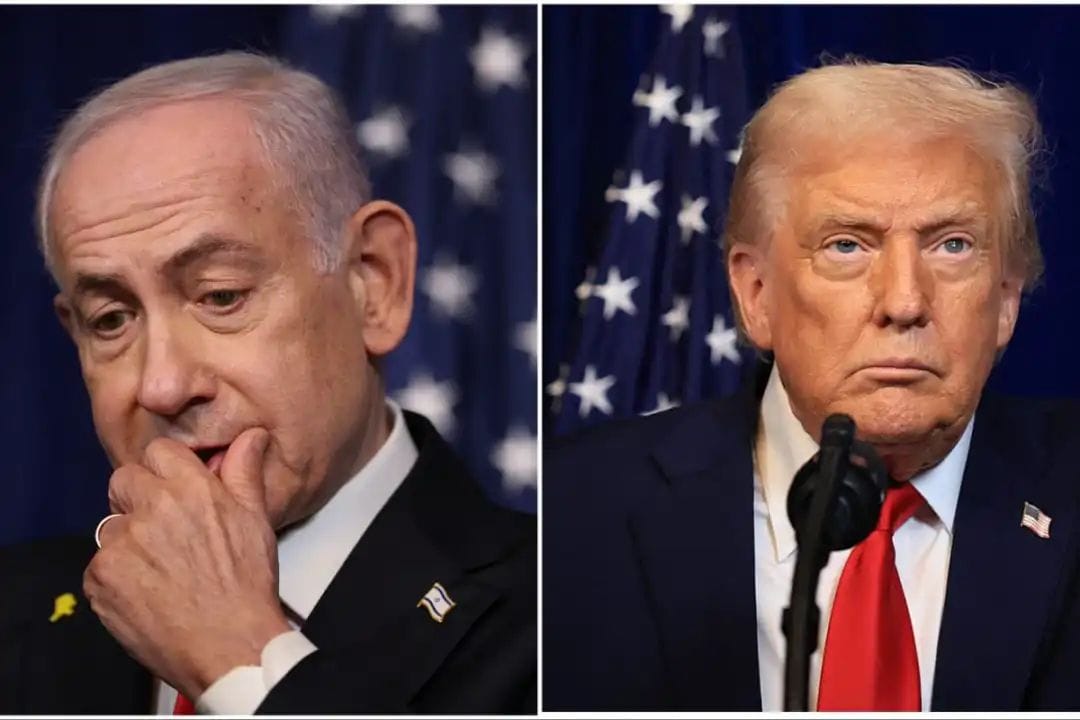
Israeli Prime Minister Benjamin Netanyahu is concerned that US President Donald Trump could agree to a deal with Iran that falls short of Israel’s core security objectives and restricts Israel’s ability to continue military operations, according to two Israeli sources cited by Axios.
The report said Israeli officials fear Washington may accept significant concessions from Tehran that would stop short of fully dismantling Iran’s nuclear programme or curbing its regional influence.
One source was quoted as saying that there is concern Trump could “decide to cut a deal and stop the war even if only some of his demands are met and postpone the rest for later without a clear solution.”
Another source said Israeli leaders are sceptical about US claims that Iran has already shown willingness to compromise on key issues, with doubts over whether Tehran has formally agreed to the concessions presented by Washington.
According to the report, the US and regional mediators, including Pakistan, Egypt and Turkey, are exploring the possibility of holding high-level peace talks with Iran as early as Thursday, though Tehran has yet to confirm participation.
Pakistan has indicated it is prepared to host negotiations, with Trump publicly sharing the message as a sign of interest in convening a summit.
Washington has sent Iran a 15-point proposal aimed at ending the conflict, with Trump saying the US is speaking to “the right people” in Tehran and suggesting Iran wants to reach an agreement.
However, Iranian officials have denied direct talks, with parliament speaker Mohammad Baqer Qalibaf dismissing such claims as “fake news”.
Trump expressed optimism about diplomacy despite continued violence, pointing to Iranian assurances that “non-hostile vessels” may pass through the Strait of Hormuz as a potential confidence-building step.
The US proposal, shared with Israel, aligns with several long-standing Israeli demands, but officials cited by Axios expressed doubts that Iran would accept the full set of conditions.
According to the report, the plan calls for zero uranium enrichment in Iran, stricter international inspections and limits on Tehran’s missile programme.
A US source told Axios that Iran had indicated willingness to give up its stockpile of highly enriched uranium, though it remains unclear whether any binding commitment has been made by Iranian decision-makers.
Israeli intelligence believes there remains a significant gap between the US and Iranian positions, the report mentioned, with concerns that partial concessions could leave key elements of Iran’s nuclear infrastructure intact.
KEY POINTS IN THE US 15-POINT PROPOSAL
The US framework includes several major conditions aimed at addressing nuclear and regional security concerns:
- Iran must dismantle its existing nuclear capabilities.
- Iran must commit never to pursue nuclear weapons.
- There will be no uranium enrichment on Iranian territory.
- Iran must hand its stockpile of about 450 kilograms of uranium enriched to 60 per cent to the International Atomic Energy Agency (IAEA).
- The Natanz, Isfahan and Fordow nuclear facilities must be dismantled.
- The IAEA must be granted full access and oversight within Iran.
- Iran must abandon its regional proxy strategy.
- Iran must cease funding, directing and arming proxy groups.
- The Strait of Hormuz must remain open as a free maritime corridor.
- Iran’s missile programme must be limited in range and quantity.
- Future missile use would be restricted to self-defence purposes.
- The plan also includes discussions around a possible ceasefire period to allow negotiations to continue.
Axios reported that uncertainty within Iran’s leadership structure has complicated diplomatic outreach, with US officials suggesting internal divisions are affecting communication between decision-makers.
The uncertain condition of Iran’s new supreme leader, Mojtaba Khamenei, has added to doubts about who holds authority to approve concessions, according to the report.
Some Iranian officials have suggested Trump’s statements about diplomatic progress may be aimed at stabilising markets or buying time for military preparations.
AFP reported that Iran has signalled it would allow safe passage for certain oil shipments through the Strait of Hormuz, a key route for roughly one-fifth of global oil supply. However, military exchanges between Iran and Israel have continued.
Even as diplomatic options are explored, both sides continue to prepare for escalation.
Reuters reported that the US is expected to deploy thousands of troops from the Army’s 82nd Airborne Division to the Middle East, adding to an existing force of around 50,000 personnel in the region.
Axios reported that US and Israeli officials are planning for at least two to three more weeks of fighting, regardless of whether talks take place.
Meanwhile, Israeli strikes have continued across Iran and Lebanon, while Iran has launched retaliatory missile and drone attacks targeting Israel and US-aligned Gulf states.
The White House has described the situation as “fluid,” with Trump pursuing diplomacy while maintaining the option of further military action if negotiations fail.