

Court Says Prosecution Failed to Prove Survivor’s Minority; Observes Case Stemmed from ‘Love Affair’
Srinagar, Apr 28 :
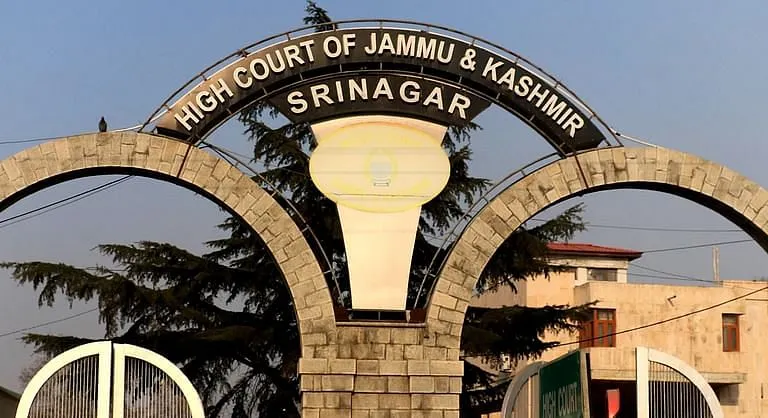
The High Court of Jammu & Kashmir and Ladakh has acquitted a man convicted in a rape case, holding that the relationship between the accused and the survivor was consensual and that the prosecution failed to establish her minority beyond reasonable doubt.
As per details available with news agency Kashmir News Corner — KNC, the case was heard by Justice Sanjay Dhar, who set aside the conviction and sentence awarded by a trial court in March 2025, which had sentenced the accused to eight years of rigorous imprisonment under Section 376 of the Ranbir Penal Code.
In his order dated April 24, the court observed that the material on record clearly indicated a “love affair” between the two, who were studying in the same school at the relevant time. The court noted that even if it is assumed—though not conclusively proved—that the survivor was below 18 years of age, the facts and circumstances of the case did not justify convicting the accused for rape.
“It is also clear that there was a love affair between the two… even if it is assumed that the victim was less than eighteen years of age, still then… convicting the petitioner would be unjust,” the court observed.
The High Court further remarked that the criminal prosecution appeared to have been initiated due to the “adamant attitude” of the survivor’s family, despite the consensual nature of the relationship between the two young persons.
The case dates back to 2018, when an FIR was registered alleging that the accused had kidnapped the survivor and established physical relations with her, leading to pregnancy. During the trial, the prosecution relied on school records to claim that the survivor was a minor, thereby rendering her consent legally immaterial.
However, the High Court found that such records do not constitute conclusive proof of age. Referring to settled legal principles and judgments, the court held that entries in school admission registers or certificates may be admissible but cannot be treated as definitive proof unless supported by reliable evidence regarding their basis.
The court emphasized that the burden lies on the prosecution to prove every ingredient of the offence, including the age of the survivor, beyond reasonable doubt. In the present case, it held that the prosecution failed to discharge this burden.
Examining the survivor’s statements recorded during trial and before the magistrate, the court noted that she had admitted being in love with the accused and voluntarily accompanying him. She also acknowledged that the physical relationship between them was consensual.
The court observed that the survivor had deposed that she was studying in Class 12 at the time of the incident and later in first-year BA, and had developed a relationship with the accused out of her own free will. It further noted that she had accompanied him to Jammu, stayed with him for two days, and expressed her desire to marry him, which was opposed by her family.
The High Court also took note of the closeness in age between the two and held that putting the accused behind bars in such circumstances would amount to a “perversion of justice.”
The accused had challenged the trial court judgment on the grounds that the findings were contrary to evidence and that there was no cogent material to prove that the survivor was below 18 years of age at the time of the alleged incident.
Allowing the appeal, the High Court concluded that the case did not constitute statutory rape, as the essential ingredient of minority was not proved, and the relationship was consensual.
Accordingly, the conviction and sentence were set aside, and the accused was acquitted of all charges. Further legal proceedings related to the case, if any, remain subject to law. (KNC)