

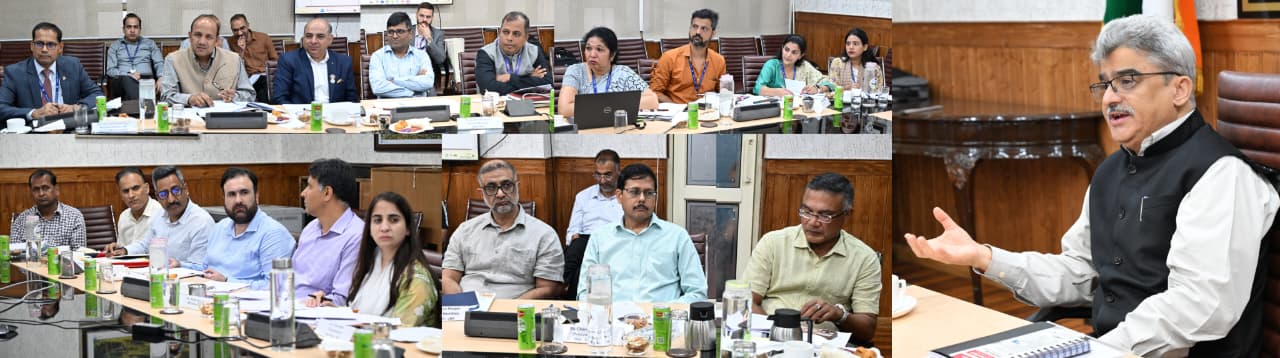
Chairs 37th UT Level Coordination Committee meeting of RBI
SRINAGAR, JULY 08:
Chief Secretary, Atal Dulloo, today chaired the 37th Union Territory Level Coordination Committee (UTLCC) meeting convened by the Reserve Bank of India (RBI), Jammu, and called for a comprehensive, coordinated and technology-driven strategy to curb the growing menace of cyber-enabled financial frauds and other unregulated financial activities in Jammu and Kashmir.
Emphasising the need for strengthening institutional capacities, the Chief Secretary urged regulatory bodies including the Securities and Exchange Board of India (SEBI), National Stock Exchange (NSE) and the Institute of Chartered Accountants of India (ICAI) to undertake large-scale capacity building programmes for prosecution and investigation officers to enhance their ability to effectively investigate and prosecute cyber-enabled financial crimes.
The UTLCC, constituted by the Ministry of Finance, GoI serves as a statutory coordination forum to promote close cooperation among financial regulators and enforcement agencies, curb unauthorised deposit-taking and other unregulated financial activities, and facilitate timely sharing of market intelligence.
The meeting was attended by Additional Chief Secretary, Finance; Regional Director, RBI, Jammu; Principal Secretary, Home Department; Inspector General of Police, Crime; Commissioner Secretary, Law Department; Director, Industries & Commerce, Kashmir; Joint Director (Headquarters), Information Department; General Manager, RBI; Registrar, Cooperative Societies; representatives of the Market Intelligence Unit of RBI, SEBI and ICAI, besides other senior officers.
During the deliberations, the Chief Secretary underscored the importance of creating widespread financial awareness and enhancing institutional preparedness against emerging financial crimes. He urged SEBI and NSE to jointly undertake awareness and training programmes targeting nearly 50,000 participants, while asking ICAI to strengthen the capacities of around 20,000 stakeholders, including teachers, students, Self Help Group (SHG) members, community influencers, law enforcement personnel and officers involved in prosecution.
Highlighting the need for stronger enforcement mechanisms, Dulloo called for the formulation of a comprehensive Standard Operating Procedure (SOP) in consultation with the Principal Secretary, Home Department. He observed that a well-defined SOP would create greater deterrence against financial offenders by clearly delineating the responsibilities of various departments and agencies, ensuring seamless coordination and facilitating swift action against fraudsters.
The Chief Secretary also directed the Finance Department to expedite the finalisation of the Chit Fund Rules to strengthen the regulatory framework and effectively curb unauthorised deposit-taking and fraudulent investment schemes in the Union Territory.
Expressing concern over the rapid evolution of technology-driven financial crimes, he stressed the need to intensify efforts against emerging frauds, particularly crypto currency related scams and other sophisticated cyber-enabled offences.
He called for identifying the masterminds behind phishing messages, fraudulent emails and similar cyber frauds, besides advocating stringent non-kinetic measures such as cancellation of driving licences, passports and vehicle registration certificates, along with attachment of properties under relevant legal provisions against those involved in cheating people of their hard-earned money.
Earlier, Regional Director, RBI, Jammu, Chandra Shekhar Azad, made a detailed presentation on the initiatives undertaken by the Reserve Bank of India to strengthen the country’s financial fraud prevention ecosystem.
He highlighted the deployment of the Financial Fraud Risk Adapter tool by RBI to banks for strengthening fraud detection and prevention. He also elaborated on several other technological and regulatory interventions, including the Artificial Intelligence-based Mule Hunter tool for identifying mule accounts, mandatory adoption of the “bank.in” domain by banks operating in India, standardisation of 1400 and 1600 series telephone numbers for promotional and customer awareness calls respectively, tokenisation of card details to secure online transactions, and customer-enabled options for disabling selected features of debit/credit cards and internet banking services to enhance account security.
The Regional Director further informed the meeting that RBI has significantly intensified financial literacy and awareness campaigns across Jammu and Kashmir. He stated that more than 113 awareness programmes have been organised across various districts and institutions, benefitting government employees, students, traders, business establishments and members of the general public.
Additional Chief Secretary, Finance, and Principal Secretary, Home Department, also shared valuable suggestions for strengthening the Union Territory’s response to cyber-enabled financial frauds. They emphasised the need for introducing distinct call signatures for whitelisted and other entities, while advocating sustained public awareness campaigns on the modus operandi adopted by cyber fraudsters, reporting mechanisms and preventive tools available to safeguard citizens against online financial crimes.