

Focus on rehabilitation, family-based care, institutional strengthening and effective implementation during consultation
SRINAGAR, SEPTEMBER 5 :
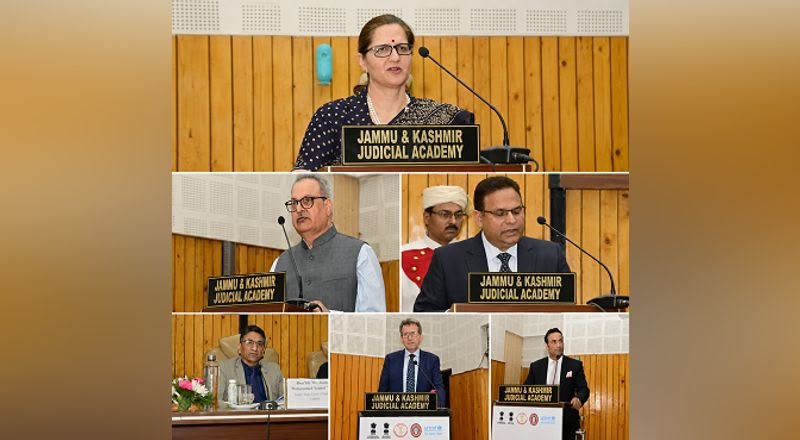
The Juvenile Justice Committee of the High Court of Jammu & Kashmir and Ladakh, in collaboration with UNICEF India, convened a one-day annual consultation to mark 10 years of implementation of the Juvenile Justice (Care and Protection of Children) Act, 2015, with a focus on strengthening the child protection and juvenile justice system for the coming decade.
The consultation, titled “Juvenile Justice (Care and Protection of Children) Act, 2015: A Decade of Implementation and the Way Forward,” was held at the J&K Judicial Academy, Mominabad, Srinagar.
The programme brought together Judges of the High Court, Judicial Officers, Principal Magistrates of Juvenile Justice Boards (JJBs), Chairpersons of Child Welfare Committees (CWCs), officers of Special Juvenile Police Units, senior government officials, Legal Services Authorities, child protection professionals, mental health experts, civil society representatives and academicians.
Participants from Jammu and Ladakh joined the proceedings virtually, making the consultation a wider platform for reviewing the implementation of the Act across both Union Territories.
Justice Sindhu Sharma: Child in Conflict with Law Remains a Child
Justice Sindhu Sharma, Judge of the High Court of J&K and Ladakh and Chairperson of the Juvenile Justice Committee, stressed that the juvenile justice system must remain firmly rooted in fairness, rehabilitation, dignity and the developmental needs of children.
In her presidential address, Justice Sharma emphasised that a child in conflict with law must continue to be treated primarily as a child and that the system should remain guided by reformative and child-sensitive principles reflected in the Beijing Rules.
She also underlined the challenge of balancing the reformative approach with concerns relating to serious offences, stressing the importance of adequately resourced institutions, trained personnel, effective data-management systems and stronger accountability mechanisms.
Justice Sharma observed that while the first decade had largely focused on establishing the institutional architecture of juvenile justice, the next decade must focus on ensuring that these institutions deliver meaningful, child-centred outcomes.
She called for a system that safeguards the dignity of every child while providing genuine opportunities for rehabilitation, reintegration and a better future.
Justice Akram Chowdhary Calls for Better Infrastructure and Coordination
Justice Mohd. Akram Chowdhary, Judge of the High Court and Member of the Juvenile Justice Committee, described the completion of ten years of the JJ Act as an opportunity to undertake an objective assessment of its implementation.
While acknowledging the functioning of Juvenile Justice Boards and Child Welfare Committees across J&K and Ladakh, he said the ultimate measure of the system’s success should be its impact on the lives of children.
He called for strengthening infrastructure, ensuring trained manpower, continuous capacity-building, adequate administrative and financial support, periodic evaluation and better coordination between departments and institutions dealing with children.
Justice Nargal Advocates Multidisciplinary Approach
Justice Wasim Sadiq Nargal emphasised that juvenile justice cannot be viewed merely through the prism of law and requires a comprehensive multidisciplinary approach.
Reflecting on the decade-long implementation of the Act, he stressed the need to identify and address gaps at the ground level and improve service delivery.
He also highlighted issues concerning children above 16 years of age accused of heinous offences, confidentiality of juvenile records and the effective functioning of Juvenile Justice Boards and Child Welfare Committees.
Justice Nargal further stressed the importance of child-centric adoption procedures, adequate infrastructure, trained personnel and administrative support, stating that the Act must be implemented in letter and spirit to ensure protection, rehabilitation, dignity and hope for vulnerable children.
UNICEF Highlights Progress, Identifies Priorities for Next Decade
Jesper Moller, Deputy Representative (Programme), UNICEF India Country Office, described the completion of ten years of the Juvenile Justice Act as an important milestone requiring a comprehensive assessment of its actual impact on children.
He highlighted progress made in Jammu & Kashmir in areas such as prevention and family-based care, Child-Friendly Spaces, Adolescent Resource Centres, strengthening of Child Care Institutions and capacity-building of frontline workers.
Moller noted that more than 9,000 frontline workers have been trained, while identifying prevention, family-based care, institutional coordination, accountability and disability inclusion among the key priorities for the coming decade.
Call for Collective Responsibility in Child Protection
Earlier, Naseer Ahmed Dar, Director, J&K Judicial Academy and Ex-Officio Member Secretary, Juvenile Justice Committee, welcomed the participants and emphasised that juvenile justice and child protection are shared responsibilities requiring coordinated efforts from all stakeholders.
He called for candid, constructive and solution-oriented deliberations aimed at developing practical recommendations for the 2026–27 Action Plan, with the best interests, dignity, safety and rehabilitation of children remaining at the centre of all interventions.
Four Thematic Sessions Held
The consultation was divided into four thematic sessions covering major aspects of juvenile justice and child protection.
The first session, “An Overview of the Implementation of the Juvenile Justice (Care and Protection of Children) Act, 2015,” was chaired by Justice Mohd. Akram Chowdhary and focused on implementation trends, accountability, child protection service delivery and institutional functioning.
The second session, “Rights of Children in Need of Care and Protection,” chaired by Justice Wasim Sadiq Nargal, deliberated on issues concerning vulnerable and out-of-school children, mental health and psychosocial support, legal aid, witness protection, rehabilitation, family-based care and aftercare.
The participants also discussed coordination among Child Welfare Committees, District Child Protection Units, Special Juvenile Police Units, Child Helplines and District Magistrates.
The third session, “Preliminary Assessment in Heinous Crimes by Juvenile Justice Boards,” was chaired by Justice Mohammad Yousuf Wani. It examined preliminary assessment under Section 15 of the JJ Act, including child-sensitive assessment, expert assistance, age determination, transfer to the adult justice system and relevant psychosocial factors.
The fourth session, “Pathways to Permanency: Adoption,” focused on adoption from the perspective of the long-term welfare and best interests of children. Discussions centred on case management, timely adoption, monitoring and coordination among Child Welfare Committees, District Child Protection Units, Specialised Adoption Agencies and District Magistrates.
2026–27 Action Plan to Focus on Practical Reforms
The valedictory session focused on consolidating the day’s deliberations and identifying actionable priorities for the 2026–2027 Action Plan.
Hilal Ahmad Bhat, Child Protection Specialist, UNICEF India, presented the key action points and takeaways emerging from the consultation, followed by concluding remarks from Justice Sindhu Sharma.
The programme concluded with a vote of thanks delivered by Naseer Ahmed Dar.
The consultation provided a significant platform for interdisciplinary and inter-institutional dialogue on improving implementation of the Juvenile Justice Act and strengthening the broader child protection framework across J&K and Ladakh.
The deliberations emphasised that the next phase of juvenile justice reforms must move beyond merely creating institutional structures and instead concentrate on effective implementation, accountability, rehabilitation, family-based care, professional capacity-building and the overall well-being of children.
The central message emerging from the consultation was clear: every child—whether in conflict with law or in need of care and protection—must be treated with dignity and provided meaningful opportunities for rehabilitation, reintegration and a secure future.(KNC)