

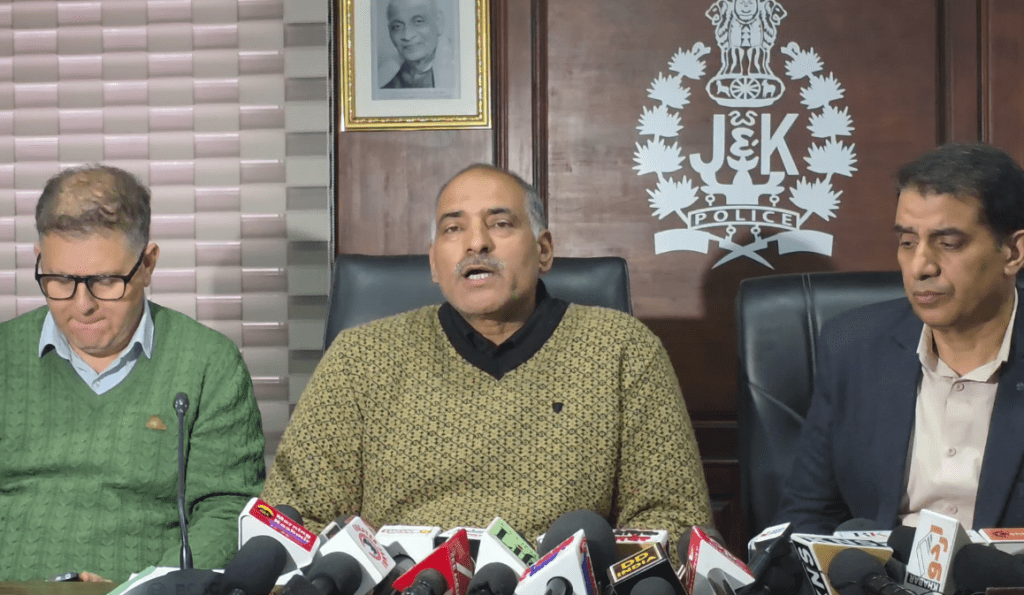
Rs 22 lakh recovered; victims of fraud up to Rs 50,000 may not need court orders, call 1930 immediately: CICE, Dy SP Ashiq Hussain Malik
Rehan Qayoom Mir
Srinagar, Apr 11 :
Amid a growing surge in cyber crime cases across Kashmir, the Cyber Crime Investigation Centre for Excellence (CICE), Crime Branch Srinagar, on Saturday said over 22 lakh Rs has been recovered in the last three months, even as officials underlined that lack of awareness continues to be the biggest factor behind people falling prey to online frauds.
Addressing a media workshop here to expand awareness on cyber crime, Deputy Superintendent of Police (Dy SP) Ashiq Hussain Malik, as reported by the news agency—Kashmir News Observer (KNO), said cyber crime is increasing proportionately with technological advancement, making every individual with a phone or internet access vulnerable.
“Today, there is hardly any person, educated or uneducated, who does not have a phone. The moment a person has an internet-enabled device, he becomes vulnerable to cyber fraud. Awareness is the only way to prevent such crimes,” he said.
Malik said the purpose of engaging media was to ensure that awareness messages reach the masses beyond limited institutional programmes. “Our awareness campaigns are often confined to offices or institutions. Through media, the same message can reach lakhs of people at once,” he added.
He said children are increasingly targeted through social media platforms where their accounts are hacked, photographs misused or morphed using artificial intelligence and later used for blackmail.
“These images are altered in such a way that they become highly objectionable, and children are threatened that they will be shared with family or friends,” he said.
For youth, especially students and job seekers, the Dy SP said fraudsters exploit aspirations by offering fake scholarships, admissions in reputed institutions, or lucrative job opportunities in India and abroad. “They ask for money in the name of registration, air tickets or processing. Once the payment is made, the link disappears,” he said.
He added that in the business community, fraudsters pitch highly attractive investment opportunities. “If someone offers you a product worth Rs 1000 at Rs 200, it should immediately raise suspicion. Such offers must be verified thoroughly before any transaction,” he said.
OTP, KYC and service-based frauds
Malik said many scams revolve around OTP sharing, fake KYC verification, and impersonation calls from banks or service providers. He further cited instances where fraudsters exploit situations like shortages of essential commodities, offering quick delivery in exchange for OTPs or personal details.
“In earlier times, valuables were kept in safes. Today, everything from banking to identity and money is inside your phone. Sharing credentials means handing over your entire security,” he said.
‘Digital arrest’ scam a complete myth
Highlighting a major emerging trend, the Dy SP said fraudsters are using the concept of “digital arrest” to intimidate victims, particularly elderly individuals. “There is no such legal term as digital arrest. No one can be arrested digitally. Fraudsters use fear tactics, often targeting elderly people living alone, threatening them with links to serious crimes to extort money,” he said.
The officer said that elderly persons are more vulnerable as they tend to panic under pressure, unlike younger individuals who may question such threats.
AI and impersonation risks rising
Malik warned that the rise of artificial intelligence has made cyber fraud more sophisticated, including voice cloning and identity impersonation. “In today’s AI era, a fraudster can clone someone’s voice or identity and call their relatives for money. The safest way is to always verify by calling back the concerned person,” he said.
He also cited cases of WhatsApp hacking, where fraudsters send urgent financial requests from compromised accounts. “Even if a message comes from a known contact, verify before sending money,” he advised.
Figures, recovery and funds on hold
Sharing enforcement data, the police officer said more than Rs 22 lakh has been recovered in the past three months, while a significant amount remains on hold and is in the process of being returned to victims. “There is still a large amount that has been lost, and efforts are being made to recover it,” he said.
He also elaborated on new measures introduced by the Indian Cyber Crime Coordination Centre (I4C), stating that victims of fraud up to Rs 50,000 may not need to approach courts for recovery. “If the cyber police station is satisfied that the claim is genuine, it can recommend that the bank release the amount directly,” he said.
However, Malik pointed out practical challenges in implementation. As per the Standard Operating Procedure (SOP), the victim must approach their bank branch and file a grievance, after which the bank manager seeks a report from the concerned cyber police station.
“Many bank managers are still not fully aware of this process, causing delays. Some may hesitate to take responsibility and refuse release, but there are higher grievance levels where victims can escalate,” he said.
He also referred to earlier difficulties where victims were required to obtain court orders, often spending more on legal fees than the amount defrauded.
Immediate response crucial: 1930 helpline
The Dy SP stressed that immediate reporting is critical in financial fraud cases. “Call 1930 without delay. The transaction can be frozen instantly, but it does not take even a minute,” he said.
He described the helpline, along with the National Cyber Crime Reporting Portal (cybercrime.gov.in), as “lifelines” for victims, adding that the helpline operates 24×7 despite occasional congestion.
Online gaming, fake ads and regulation gaps
On online gaming frauds, Malik said several platforms involving monetary transactions have been banned, with hundreds of websites blocked, though fraudsters continue to evolve.
He also raised concerns over unregulated online advertisements on social media, which mislead users. “Action can be taken if such content is reported, but authorities depend on public complaints as there is no automatic detection mechanism,” he said.
The officer cautioned against posting or commenting on individuals, such as doctors, without consent on social media, warning that such actions may violate legal provisions.
In addition to cyber crime, he highlighted rising drug addiction in Jammu and Kashmir, calling it a more serious societal threat. He said teenagers and young individuals are particularly vulnerable and urged parents to remain vigilant.
Malik described the media as a crucial partner in combating cyber crime. “Through media, awareness can reach lakhs of people instantly. If awareness spreads, fraud will reduce,” he said.
He urged citizens to remain cautious, verify all digital interactions, avoid sharing sensitive information and report any suspicious activity promptly to prevent losses.—(KNO)