

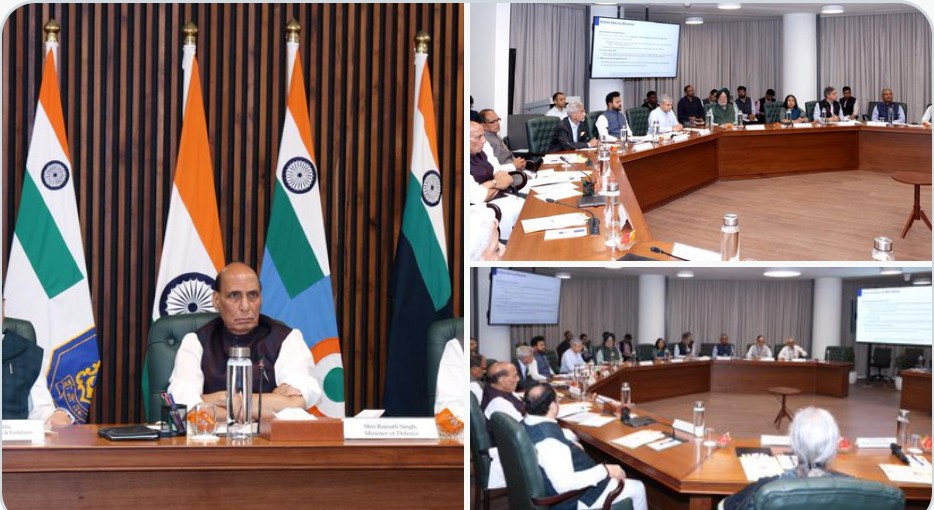
Govt assures uninterrupted supply of fuel, LPG, fertilisers and essential commodities; focus on preparedness, coordination and resilience
Srinagar, Apr 8 :
The Centre on Wednesday reviewed India’s overall preparedness in view of the evolving situation in West Asia, with Defence Minister Rajnath Singh chairing a high-level meeting of the Informal Group of Ministers (IGoM) in New Delhi.
The Informal Group of Ministers (IGoM), headed by Raksha Mantri Shri Rajnath Singh, took stock of India’s readiness in view of the recent developments in West Asia during its third meeting at Kartavya Bhawan-2, New Delhi on April 08, 2026. Minister of Finance & Corporate Affairs Smt Nirmala Sitharaman; Minister of External Affairs Dr S Jaishankar; Minister for Agriculture & Farmers’ Welfare and Rural Development Shri Shivraj Singh Chouhan; Minister of Commerce and Industry Shri Piyush Goyal; Minister of Chemicals & Fertilizers Shri Jagat Prakash Nadda; Minister of Petroleum and Natural Gas Shri Hardeep Singh Puri; Minister of Consumer Affairs, Food and Public Distribution Shri Prahlad Joshi; Minister of Railways, Information and Broadcasting, Electronics & Information Technology Shri Ashwini Vaishnaw; Minister of Parliamentary Affairs Shri Kiren Rijiju; Minister of Civil Aviation Shri Kinjarapu Rammohan Naidu, and Minister of State (Independent Charge) of the Ministry of Science & Technology Dr Jitendra Singh attended the meeting.
In his remarks, Raksha Mantri directed all departments to continue focusing on preparedness, coordination, and resilience building to stay ready to deal with any eventuality. In a post on X, he stated that the Government is ensuring continued availability of LPG, petrol and diesel, fertilisers for farmers and facilitating supply of essential commodities in the country. The Government, under the leadership of Prime Minister Shri Narendra Modi, has been doing exceptional work in safeguarding the citizens from the impact of the conflict, he said.
The iGoM was informed that India has ensured the evacuation of the highest number of vessels than any other country, from the Strait of Hormuz over the past 40 days. A total of 8 LPG vessels, carrying approximately 340TM, equivalent to around 11 days of India’s import requirement have successfully transited the Strait, reinforcing the country’s energy security and supply stability. There have been no reports of dry-out at LPG distributorships, and delivery of domestic LPG cylinders continues despite all across the country.
In order to support the vulnerable communities including migrant labourers, the supply of 5kg Free Trade LPG cylinders has been doubled beyond the 20% allocation earmarked for priority segments on 7 April. Oil PSU retail pump outlets continue to dispense auto LPG to support the public transportation requirements. However, some supply constraints are being faced by private operators due to their procurement challenges, causing increased footfall in PSU outlets.
A major decision was taken on 8 April to further ease supply of LPG to industrial segments by allocating 70% of fuel demand to non-domestic bulk consumers with supply prioritised for key sectors such as pharma, food, polymers, agriculture, packaging, paints, steel, defence-related materials, etc. This measure is expected to prevent supply-chain disruptions, avoid shortages of essential goods and ensure continuity of industrial operations despite the ongoing global crisis.
Piped Natural Gas (PNG) is being actively promoted wherever feasible. Owing to the increased awareness from the PNG connection campaign launched to reduce LPG dependence, 3.16 lakh new PNG connections were added, representing a three fold increase over March 2025 levels.The campaign has also resulted in the surrender of 16,700+ LPG connections by citizens, indicating a growing shift toward PNG adoption.
The IGoM was also briefed about the easing in energy prices in the light of the ceasefire. The Ministers were informed that key sectoral parameters will continue to be closely monitored and appropriate measures will be taken.
The IGoM was also apprised about the adequate measures taken by the Department of Food and Public Distribution.
Food Security Preparedness
Adequate buffer stocks of rice and wheat are available, ensuring sufficient supply for PDS as well as to meet any emergency requirements. The National Food Security Act ensures continued access to foodgrains for vulnerable populations.
Market Intervention: Open Market Sale Scheme (Domestic) – OMSS (D)
The Government monitors foodgrain prices and, when necessary, undertakes market intervention through OMSS (D). The Food Corporation of India (FCI) releases surplus wheat and rice in the open market to augment supply, stabilise prices, and contain inflation. Adequate stocks are available with FCI for such interventions. The scheme also enables the sale of rice to the State Governments at subsidised fixed prices for additional requirements.
Procurement: Rabi Marketing Season (RMS) 2026–27
Procurement of wheat under MSP operations has started, primarily through State Government agencies. The Department is regularly reviewing preparedness in coordination with States. Adequate packaging material is being ensured for procurement operations.
Foodgrain Packaging
Proactive steps have been taken to ensure the availability of packaging materials during RMS 2026–27. The Department, in consultation with the Ministry of Petroleum and Natural Gas and Department of Chemicals and Petrochemicals, is diversifying packaging sources and maintaining contingency measures to address any shortfall.
Edible Oil Scenario
Domestic availability of edible oils remains comfortable despite global uncertainties. Imports from key partners (Indonesia, Malaysia, Argentina, Brazil) continue steadily. Improved mustard production has strengthened domestic supply. Overall supply remains stable; the Government continues close monitoring and will intervene if required.
Sugar Sector
Adequate sugar buffer stock is available. Sugar production in 2025-26 is expected to remain sufficient. 15.80 Lakh Metric Tonnes (LMT) of sugar has been permitted for export, with 3.73 LMT exported so far. Exports are primarily to Sri Lanka, West Asia, and East Africa. Retail prices remain stable, with low inflation (~3%) over the past three years.
The Ministers were informed that the Department of Consumer Affairs is monitoring the daily prices of 40 food commodities reported from 578 centres across the country. Price trends are closely monitored for unusual volatility consequent to the outbreak of war in the Middle East. Till now, no unusual volatility is observed and prices are stable for most commodities, except moderate increase in prices of edible oils.
Domestic production of mustard oil is expected to improve (~5% higher output), partially offsetting import dependence. Procurement of onion for price stabilisation buffer will begin shortly, which will provide support to the mandi prices.
National Agricultural Cooperative Marketing Federation of India Limited and National Cooperative Consumers’ Federation of India Limited have started preparation for the procurement. Onion export during the Financial Year 2025-26 at 15.40 LMT was more than previous year and is expected to further improve this year. (KNC)