

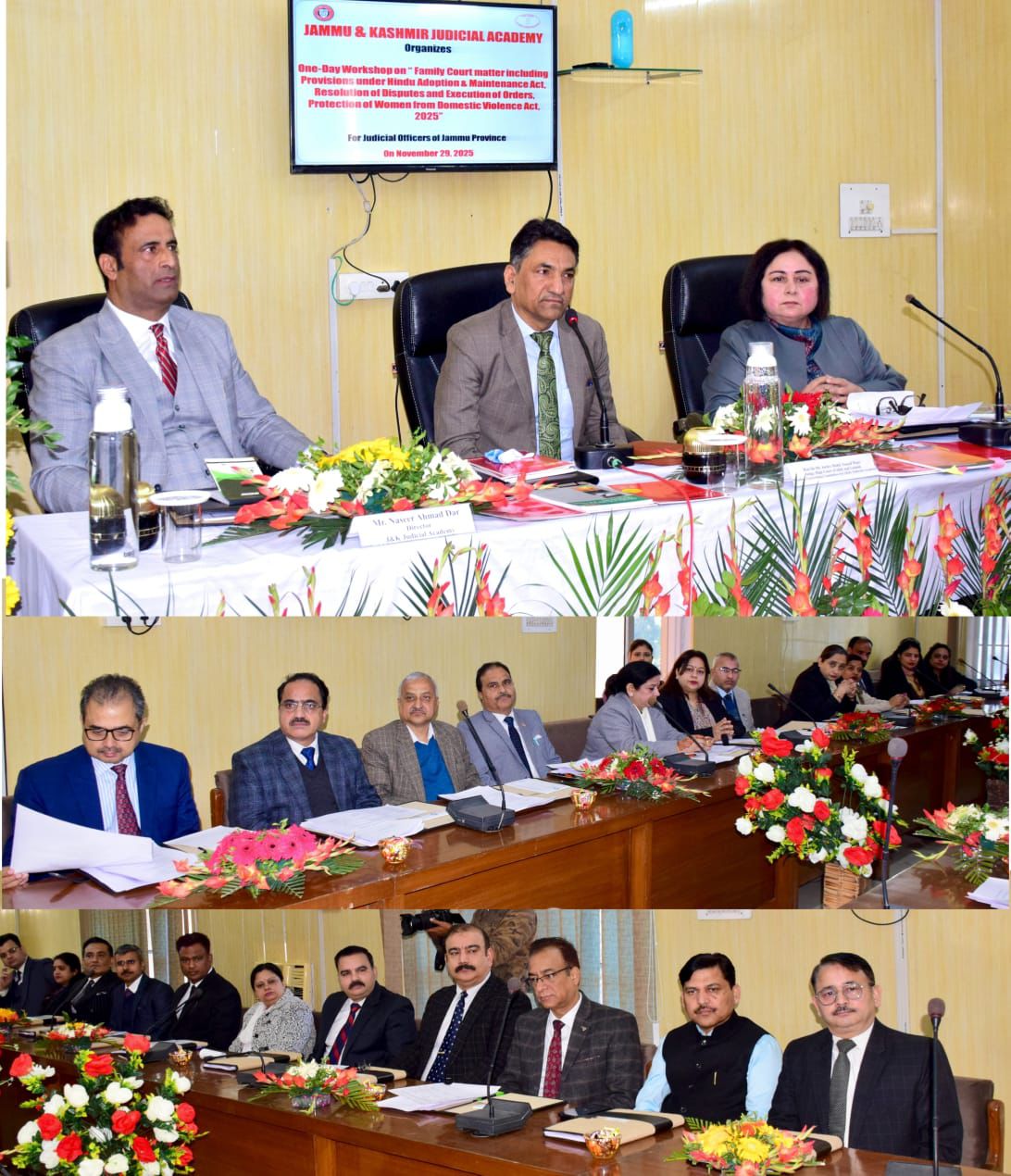
Jammu, Nov 29 :
Under the patronage of Justice Arun Palli, The Chief Justice, High Court of Jammu & Kashmir and Ladakh (Patron-in-Chief, J&K Judicial Academy), guidance of Chairperson and Members of Governing Committee for J&K Judicial Academy, Jammu & Kashmir Judicial Academy today organized a One-Day Workshop on “Family Court Matters, including provisions under the Hindu Adoption and Maintenance Act, Guardian and Wards Act, Resolution of Disputes, Execution of Orders, and the Protection of Women from Domestic Violence Act, 2005” at Janipur, Jammu.
The workshop was inaugurated by Justice Mohammad Yousuf Wani, Judge, High Court of J&K and Ladakh, and Member, Governing Committee, J&K Judicial Academy.
In his inaugural address, His Lordship noted that the growing complexity of family disputes has increased the judiciary’s responsibility to deliver timely, sensitive, and legally sound interventions.
He stressed the need for judicial officers and practitioners to stay updated with evolving laws and to adopt a humanistic approach in matters of matrimonial conflict, child custody, and domestic violence.
Justice Mohammad Yousuf Wani highlighted that the Family Courts legislation aims not only to adjudicate disputes but to help reunite families.
He observed that matrimonial conflicts often develop into serious human rights concerns affecting the emotional and psychological well-being of all family members, especially children. His Lordship emphasized that Family Courts must prioritise reconciliation, enabling parties to rebuild trust and relationships.
He further noted that judges handling family matters often act as mediators and counsellors, guiding parties toward amicable settlement.
Referring to the reconciliation-driven mandate of the Family Courts Act, His Lordship stressed that meaningful efforts at settlement should precede adjudication, as this approach strengthens family bonds and promotes social harmony.
The programme commenced with the Welcome Address by Sh. Naseer Ahmad Dar, Director, J&K Judicial Academy, who highlighted the significance of continuous judicial education in improving the administration of justice, particularly in matters relating to families, children, and vulnerable groups.
He emphasized the need for strengthening adjudicatory skills and sensitization toward litigants appearing before Family Courts.
He discussed that the Family courts require more than legal knowledge they demand patience, balance, empathy, and sound judicial discretion.
He added that a judge in these matters must maintain firmness with compassion, sensitivity with objectivity, and speed with fairness. These are not cases to be treated routinely; each case represents a family in distress.
In the first session, Ms. Bala Jyoti, Former Senior District & Sessions Judge (Super Time Scale), delivered an insightful session on Family Court matters, emphasizing that marriage is a foundational social institution and should not be treated as irretrievably broken merely because spouses live separately, as reiterated in recent Supreme Court rulings.
Highlighting the reconciliation-oriented mandate of the Family Courts Act, she stressed that courts must first make sincere efforts to assist parties toward settlement before proceeding with adjudication.
She discussed dissolution of marriage, mutual consent and contested divorce, restitution of conjugal rights under Section 9 of the Hindu Marriage Act, and key features of the Special Marriage Act, while also referring to landmark judgments such as Shilpa Sailesh V. Varun Sreenivasan on irretrievable breakdown of marriage.
The second session of the day was conducted by Ms. Mandeep Reen, Advocate, High Court of J&K and Ladakh, who deliberated on the Guardian and Wards Act, the protection of children’s rights, and the execution of orders in guardianship matters.
She emphasized the growing importance of child-centric jurisprudence, stressing that the welfare of the minor must remain the paramount consideration in every custody or guardianship determination.
Reen highlighted the responsibility of courts to ensure not just the legal protection, but also the emotional, educational, and holistic development of children involved in family disputes, and underscored the need for sensitivity and timely enforcement of orders to safeguard the best interests of the child.
In the concluding session, M.S. Parihar, Former District & Sessions Judge delivered an insightful talk on the Protection of Women from Domestic Violence Act, 2005, focusing on its purpose, scope, and practical implementation.
He elaborated on the crucial roles played by Protection Officers, Magistrates, service providers, police authorities, and support agencies in ensuring timely assistance, protection, and relief to victims of domestic violence.
Parihar emphasized the need for coordinated institutional response, sensitivity in handling complaints, and effective enforcement of protection orders to safeguard the rights and dignity of women facing domestic abuse.
The session concluded with an interactive discussion, where participants shared practical difficulties with the Learned Resource Persons and explored solutions.