


Written
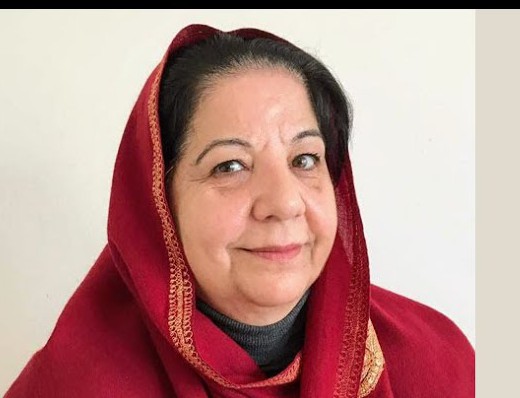
By Nayeema Ahmad Mahjoor
The decision to leave the BBC and return to Radio Kashmir was a leap of faith, one I was determined to take
This was the time when the first state elections, following the violent situation in the
Valley, were held in 1996.
The time when Farooq Abdullah had
to pay a fine for illegal parking while visiting me at the BBC London after he was
offered by the Government of India a ‘sky
is the limit’ in return for his comeback in
elections. It was the time when majority in
Kashmir believed that India and Pakistan
had learnt a lesson from their betrayals in
the past and wanted to settle the Kashmir
issue for peace. ‘The bloodshed had to stop’,
perhaps everybody prayed for it.
Politicians, people and separatists – all
thought that the snow had melted.
The streams were gushing.
The Chinar leaves had turned green.
The ‘sky is the limit’ mantra enticed us
all, insiders and outsiders.
Was it a sense of responsibility or the
figment of my imagination that led me to
leave BBC London and return to the Kashmir Valley after covering the global agenda
from a distance of seven thousand miles?
Honestly, I still have no answer.
My children were furious that I had created an obstacle in their education for no
reason, interrupting their session and separating them from their friends. I did not
know whether they would get admission in
Kashmir or their year would be wasted. Many
friends at the BBC advised me to reconsider
my decision to move to Kashmir. They rather
thought that I should settle permanently in
London, as there was ample space at the BBC
where I could do my work. I disagreed.
Despite my indecision, I was resolute
in making the right choice for me and my
family. The decision to leave the BBC and
return to Radio Kashmir was a leap of faith,
one I was determined to take.
My father, Baba, was my troubleshooter,
but he was also in a dilemma about whether
I should return or stay in London. For the
first time in my life, I was drowning when
I should have been celebrating the moment
of gaining freedom to decide.
Baba had been the decision-maker for my
family; even the names of my children were
his prerogative. But this time, he backed out.
I was clouded by whispers about what I would
do if the decision to return proved a failure.
Baba’s stare scared me as if to say that
more than one crore people live in the state;
aren’t the conditions bad for them?
I returned with bag and baggage.
First, I got my children back to school,
and then I immersed myself in the world of
broadcast journalism, which was limited and
bordered. The early days were challenging,
with limited resources and a smaller platform compared to the BBC. However, I was
unwavering in my commitment to bring quality programming to the people of Kashmir.
Strangely, there was neither the enthusiasm nor the excitement that had made the
days at the BBC exciting.
The world of Radio Kashmir was much
smaller compared to the BBC. Whether it
was the management, infrastructure, or the
means to connect with the world, Radio Kashmir was lacking in many aspects. This was a
stark contrast to the BBC, where I had access
to state-of-the-art equipment and a global platform. In reality, the sky was the limit there.
I preferred to swim in a small river
instead of a vast ocean, but this river of
Radio Kashmir had no swimming equipment in it that I had become accustomed to
at BBC London.
During the few years I spent at the BBC,
I travelled to South Asia, the Middle East,
and several European countries, learning
the secrets of world politics and becoming
familiar with the codes of journalism. Then,
what should I do at Radio Kashmir, where
the recording machines are often in poor
condition? The restrictions on the content
were a sword on my head.
The journalist in me needed to be consoled,
which does not make me regret my decision
to return. My guilt would soon consume me.
Nevertheless, I resumed my position as
an officer in the Radio and started supervising a few routine programs.
Soon, I realised the journalist in me was
dying.
The resettlement had become difficult,
more due to the doubts that started to arise
about my decision to leave the ‘green pastures.’
Amid such a quagmire, one fine morning,
news came that the new director, Ashraf Sahil,
had arrived at the station, and he was immediately calling a meeting of the program officers.
His arrival brought a sense of anticipation and
hope for a better future for Radio Kashmir.
About four or five of us colleagues were
sunbathing in the courtyard of the radio
station when my clerk informed me to go
to the conference hall.
I did not know Sahil Sahib, but I had
heard that he was from Gurez. As soon as I
saw him, the images of the blue-green valleys of Gurez came to mind.
He had come to the Radio with a new
dream. He wanted to restore Radio Kashmir
to its former glory, when it was a place of
tradition due to programs like Zoon e Dub.
Sahil Sahib had come from a television
background and had achieved a lot at Doordarshan, but he found that the image of
Radio was more appealing than that of TV,
so he wanted to showcase his talents more.
All the officers of the Radio Kashmir
gathered around a round table in the conference hall when Sahil Sahib emerged from
the director’s room and addressed everyone.
After a lengthy discussion on his broadcasting career, he addressed me.
‘I am thrilled to see that you have preferred this small station of yours over the
BBC. We will not let your sincerity go waste;
instead, we will try to learn from you by
leveraging your talents. My heartfelt wish
would be that you organise a similar program here, as you have done live broadcasting for the BBC from Pakistan and Afghanistan. Please think about it.’
After this, the meeting adjourned. Every
other officer was looking at me in surprise.
I came to my room and started packing
my things. It was imperative to reach home
as soon as the children came from school.
The station car was waiting for me outside, and somehow the BBC’s Sairbeen program that I had edited for four years kept
rewinding in my mind.
The children came running as soon as
they heard the car horn. After hugging me
in turns, they started chirping like birds.
This was the first time I saw them happy.
Alhamdulillah, the children had taken a
liking to their school. Their joy was a reassuring sign that we were on the right path
in adjusting ourselves back in Kashmir.
Despite the challenges, my passion for journalism burned bright. I was not content with
just adjusting to life in Kashmir; I wanted
to do more, to create something meaningful.
It was almost two o’clock in the morning
when I suddenly woke up from my sleep.
The creation of something was taking a
mental shape.
Obviously, it was not possible to start
a program like that in the BBC. Whatever
could be done could be done on a small scale.
At least the journalist inside has to be satisfied. I stayed awake in bed until dawn and
thought in the dark.
Bingo…
As the first ray of light broke through the
darkness, a new idea began to take shape
in my mind. The program Shaharbeen was
about to be born, and I was filled with anticipation and excitement for this new chapter.
Shaharbeen will be the copycat of Sairbeen. This statement may seem paradoxical, but it encapsulates the essence of the
program. Shaharbeen, while inspired by
Sairbeen, will bring a fresh perspective and
unique content to the listeners, making it a
‘copycat’ in the best sense of the word.
As soon as my mind got peace, the call
to Fajr prayer was heard from the mosque.
The early morning sun had infused life
into the dead trees, and buds had sprouted
at their edges.
After a few hours of struggle with the
choice of breakfast, I reached office, and as
soon as I arrived, I went straight to Sahil
Sahib’s room.
His smile would transport me to Peshawar, where people with the same features
would roam the streets of Khawa Khani
Market all day.
He immediately realised.
‘I have thought about the new program. I
will start a Shaharbeen program in the style
of Sairbeen. One of my conditions is that the
editorship of this program, regarding the current situation, will remain with me alone.’ I
said it in a flash without taking a breath.
A broad smile spread on his face.
‘I agree to all the terms and conditions, and
any staff or studio facilities you require will
be available. You will inform us in advance
about the start date, duration, and format, so
that we can publicise it effectively.’
The moment I was about to leave his
office, he spoke again. ‘I am confident that
your program will prove to be the best.’
The smile of conquering the broadcasting
world was on both our faces.
Yet, my real test had begun.
The restlessness was at its peak.
Radio Kashmir’s antique machines and
the editorial issue – it was not an easy task.
Who believed the news on the Radio, or
where was the peace that the Radio kept
talking about for 24 hours? And then, due
to the violent situation, why would anyone
listen to Radio Kashmir when the BBC and
Voice of America were providing news at
regular intervals? Many times I have heard
the protestors outside shouting slogans that
‘Radio Kashmir ki jhooti Khabrein hai hai
(Radio Kashmir’s fake news, shame-shame).
Now, how can I restore their trust, or how
can I make them lean towards my program?
I was dreaming that those who call the
institution a liar would listen to my program. They had believed my credibility
while I was at the BBC. How can I be accepted at Radio Kashmir?
I lost sleep many nights. My restlessness
became visible to everyone during the day.
The wrinkles had become deeper. I put myself
through a big challenge. Children were scolding me. I was inattentive towards them.
My boss at the BBC would always tell me,
‘You are a risk taker.’
Someone should learn from me how to
take risks in life. I must be awarded.
After a week of continuous thinking, I
announced that I would start the Current
Affairs program on Monday.
The decision on the studio allotment, staff
assistance, duration and time of the programme, I prepared an outline of the fifteenminute program, which included a report
on the shortage of life-saving medicines in
the Valley and an interview with the Public
Health Secretary, reports on the worsening
flood situation in Bangladesh, the absence
of officers in the secretariat, etc., and a live
report on the firing on the Line of Control.
My first program was at 7:30 pm before
the news, and Sahil Sahib remained in the
station until the program was broadcast.
Was he doubtful of my intent or saving
his job?
When I reached the duty room after the live
broadcast, Sahil Sahib was clapping, and the
entire staff assigned to evening duty stood up
and joined in the applause. The sweat drops
on my forehead were getting hotter. I drank
a glass of cold water in a gulp to cool down.
Sahil Sahib was saying, ‘This was my dream
that we should make Radio Kashmir BBC.’
The following days were very hectic; the
station was receiving hundreds of calls,
and people were inquiring about how Radio
Kashmir was able to broadcast BBC programs from there.
Local administration officers were calling Sahil Sahib, and the Shaharbeen was
becoming a topic of conversation throughout Jammu and Kashmir.
In a few days, the number of radio listeners increased significantly, and various
delegations began to appear on the Radio,
seeking to highlight their issues.
And, in a few months, Shaharbeen
became the voice of every household, and
most of the radio officers were approaching
Sahil Sahib to give them a role in it.
I formed a large team of young journalists and trained them from writing dispatches to conducting field reporting. The
reporters were sent to administration officers for interviews, which was a first-time
occurrence in Kashmir broadcasting. Live
conversations or direct reports from remote
areas were included in the program.
The glory of the Radio started to be
restored.
Thousands of people from far-off places
came to see me, resulting in regular traffic
congestion outside the station. The Radio
was taking centre stage in managing the
affairs of the state.
In the daily program meeting, Sahil
Sahib encouraged other officers to join this
adventure, rather than staring at the walls
and talking in whispers.
To break the silence in the room, he said,
‘I wanted a current affairs program of this
type, and it has emerged completely in a
beautiful pattern.’
Several articles were written in the
newspapers on the program Shaharbeen.
When rumours of the program’s popularity reached All India Radio, New Delhi, it
was ordered that all stations in Jammu and
Kashmir would broadcast it.
Through this program, a new connection was established between the Radio, the
administration, and the public. The narrative
of fake news on the Radio began to change.
The central government summoned Sahil
Sahib to Delhi and demanded that the duration of the program be further extended.
I immediately agreed.
At the same time, the demand for all
advertisements to be aired during this program increased, which earned the station
a substantial amount of money. However,
the program time was reduced due to the
abundance of advertisements, which the
listeners disliked.
The station was flooded with letters
demanding an end to the advertisements that
would cut short the broadcast’s duration.
At times, during the broadcast, I would
forget that I was broadcasting from Radio
Kashmir, and instead, I would start including ‘forbidden’ topics.
I started liberating Radio Kashmir even
before the freedom of the media in India,
which was unpleasant for the administration in Delhi. After all, ours was not a
normal state.
Delhi reprimanded Sahil Sahib. He
snubbed me and then whispered in a low
voice, ‘This is not BBC; keep it in mind
every time you enter the Studio. I will take
care of the rest myself.’
After verbal warnings, I got written
orders several times. ‘You are exceeding the
limits by violating the code. Either follow
the rules or leave the program.’
Once, I went to Sahil Sahib’s room with
the intention of leaving Shaharbeen. He
smiled and said, ‘Keep doing a good broadcast and do not expect any reward.’
‘I never expect rewards, but not the warnings either.’’ I left the room with a big bang.
Shaharbeen continued for a year and a
half, and thanks to this program, the Radio’s
popularity soared to new heights. And my
fellow officers were inspired to breathe life
into other programs.
We were celebrating the golden jubilee of
Radio Kashmir when we suddenly received
the news that Sahil Sahib had been transferred from the Radio. The station has been
handed over to another director, who is a
Kashmiri but whose ego was soon hurt by
the program’s popularity. Before entering the
station, he had planned with a few officers to
oust me from the program because they knew
that the building they wanted to construct by
transforming the program into a means for
wealth accumulation could not be achieved
with me in place. I immediately realised that
now I would neither be allowed to run this
program as I wanted nor would this environment be tolerable for me. His loyal officers
had already started making a loud noise.
I had not yet made a decision when I
received a phone call from BBC London,
asking me to return as the editor of News
and Current Affairs on a permanent basis.
It was not difficult to guess the miracles
of Allah.
I knocked on Syed Sahib’s shrine in
Sonwar to offer my prayers of thanks.
Sitting there in solitude in a corner for a
long time proved soothing.
My soul found peace.
I left the shrine and reached the station. I
wrote a letter of voluntary resignation from
my job and sent it to the station director.
Taking my bag from the cupboard, I
asked for a car to drop me off at my home
for the last time. The children had already
received a message to return to London.
They were dancing.
My father had come. As soon as he saw
me, he hugged me, kissed my forehead and
said, ‘I entrust you and your children to
Allah and His Messenger.’
My eyes filled with tears.
Baba held me close to his chest for a long
time.
The storm had subsided.
I had returned to my homeland after spending four and a half years at the BBC. Still,
because of a few selfish officers, I decided to
put a heavy stone on my heart and go back
to the BBC in London, where there would be
no restrictions on my freedom of writing or
speech, where there would be no dishonest
officers, and where no one’s abilities would be
interpreted as weakness, and where I would
be allowed to learn journalism in forty-two
languages for almost twenty-five years.
For me, it was nothing short of a miracle
that I had reached this school of journalism
from which the whole world has learned
broadcast journalism.
Returning from Shaharbeen, I resumed
producing and editing Sairbeen and met
many prime ministers, intellectuals, military leaders, celebrities, and Nobel laureates from around the world.
Radio Kashmir continues to broadcast
Shaharbeen, and its employees have also
achieved a high level of recognition. I conceived and produced the program, giving
voice to the voiceless, and attempted to
bring people closer to the administration
in an atmosphere of uncertainty. But I give
all the credit to Ashraf Sahil, who acknowledged my abilities, appreciated my creation,
and did not put any obstacles in its broadcast. Those two years were a wonderful
period in the history of Radio, restoring
the glory of the Radio that had been missing
after the era of Zoon e Dub.
Thanks to listeners, even today, the audience continues to mention and respect me
and the contributions of Radio Kashmir.
Nayeema Ahmad Mahjoor, Author and Journalist
Radio Broadcast(naeema7@gmail.com)
(Courtesy Greater Kashmir)