

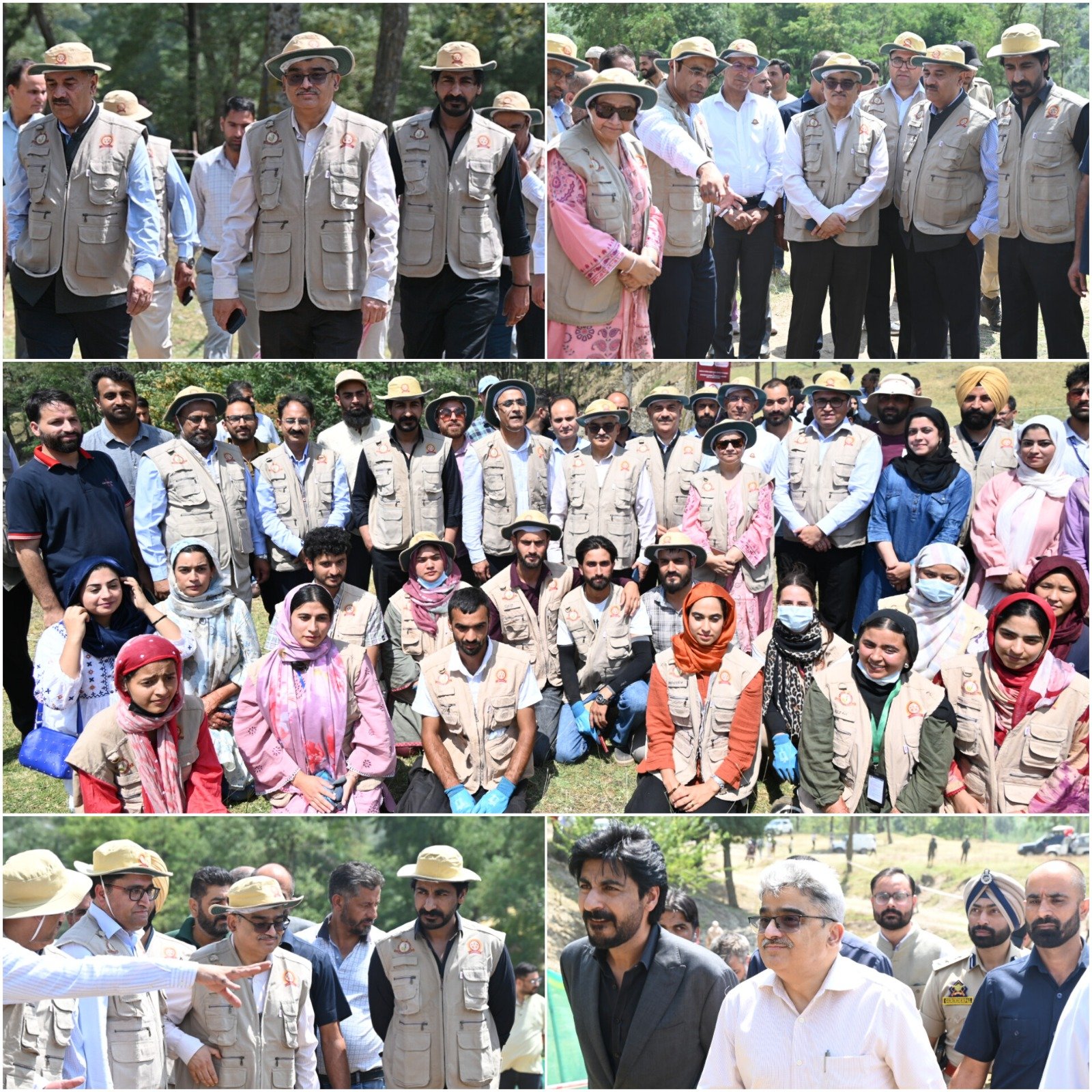
Chief Secretary J&K Government, Atal Dulloo, visited the archaeological excavation site of ancient Buddhist Stupas at Zehanpora, Sheeri.
Inayat Qayoom
Zehanpora, Aug 29:
The second phase of excavation began on Saturday at the nearly 2,000-year-old Buddhist archaeological site at Zehanpora in north Kashmir’s Baramulla district, opening a fresh chapter in the effort to uncover and scientifically document one of the region’s significant early historic sites.
The latest excavation campaign is expected to continue for around 100 days, giving archaeologists substantially more time in the field than during the first phase, which was curtailed after about a month because of the onset of harsh winter. Officials and researchers are hopeful that the extended campaign and investigation of unexplored areas will yield further structures, artefacts and other evidence capable of shedding new light on Kashmir’s ancient civilisation.
The site, located in the Uri area of Baramulla, has been identified as a Buddhist archaeological site dating back nearly 2,000 years, with evidence pointing towards the Kushan period. Historical references to the site have also been traced, and researchers are attempting to establish connections between the accounts preserved in historical records and the archaeological evidence emerging from the ground.
Jammu and Kashmir Chief Secretary Atal Dulloo, who visited the historic site and inspected the ongoing archaeological work, described the discoveries made during the first phase as “surprising and very interesting”, expressing hope that further excavation would reveal more about the ancient civilisation that once flourished in the area.
“The main things that are understood so far, however, when they do the whole excavation, the whole story will be revealed,” Dulloo said, underlining that the significance of the site could only be fully assessed after a more extensive excavation.
The Chief Secretary was accompanied during his visit by University of Kashmir Vice-Chancellor Prof. Neelofar Khan, Deputy Commissioner Baramulla Syed Fakhruddin Hamid, SSP Baramulla Gurinderpal Singh and other senior officials. He took stock of the archaeological work and appreciated the efforts being made to explore, document and preserve Jammu and Kashmir’s ancient heritage.
The excavation is being carried out through institutional collaboration between the Directorate of Archives, Archaeology and Museums (DAAM), J&K, and the University of Kashmir. An MoU for archaeological excavation at Zehanpora was signed last year, paving the way for systematic research at the site after the required permissions were obtained.
The first phase began in November 2025 but had to be curtailed because of the arrival of cold weather. The second campaign now provides researchers with around three months of fieldwork, compared with only about a month during the previous season. Expanded trenches and focused investigations are planned across unexplored portions of the archaeological site.
The excavation is being conducted using scientific methods and modern archaeological technology. Material recovered from the site is being subjected to various tests, including carbon dating, to establish its chronology and help researchers understand the cultural sequence represented by the remains.
University of Kashmir students are also participating in the fieldwork, giving them practical exposure to archaeological research, excavation techniques, documentation and scientific investigation. Dulloo congratulated the university, its Department of Archaeology and the participating students for their involvement, describing the exercise as an important opportunity for hands-on academic learning.
The importance of Zehanpora became increasingly evident after archival research and satellite-based surveys indicated the presence of buried structures. Subsequent archaeological excavation has revealed multiple stupas, apsidal structures, monastic remains, pottery, terracotta objects and other material culture associated with Buddhist occupation.
The discoveries suggest the presence of a substantial Buddhist monastic complex dating to the Kushan dynasty, broadly between the 1st and 3rd centuries CE, a period during which Buddhism flourished across large parts of northern India and Kashmir was connected to wider cultural and commercial networks.
Zehanpora’s location along an ancient cultural corridor close to the Jhelum River further adds to its significance. The route was historically associated with religious exchange and trade and is believed to have connected Kashmir with wider regions, including Gandhara and Central Asia.
Researchers believe the structures and artefacts being unearthed can provide clues about the tools, construction materials, religious practices and everyday life of the people who inhabited the settlement nearly two millennia ago.
Surveyor in the Department of Archives and Archaeology, Dr Javid, who has been associated with the excavation and survey work, has described the site as having rare archaeological continuity.
“Zehanpora offers rare archaeological continuity. The material culture emerging from the site will help bridge critical gaps in the historical narrative of the Kashmir Valley and place Baramulla prominently on the archaeological map of South Asia,” he observed.
The Zehanpora excavation has also received national attention following its mention by Prime Minister Narendra Modi in the 129th episode of Mann Ki Baat.
While speaking about Kashmir’s rich Buddhist heritage and the scientific revelations emerging from the site, the Prime Minister referred to the role of archival research in bringing the forgotten ruins back into focus. A blurred 19th-century photograph discovered in a French museum helped draw attention to the long-overlooked remains, leading to scientific surveys and subsequent archaeological excavation.
Modi noted that the remains date back nearly 2,000 years to the Kushan period, highlighting Kashmir’s place in the ancient Buddhist world.
“These large human-made structures, revealed through scientific study and archival images, remind us of Kashmir’s glorious and plural cultural heritage,” the Prime Minister said during the programme.
The excavation has been progressing under the guidance of Project Director Dr Ajmal Shah, whose team has welcomed the national recognition of the work.
Dr Shah described the Prime Minister’s appreciation as deeply encouraging and motivating, saying it would inspire the research team to continue its work with greater patience, dedication and scientific rigour in the coming years.
Site museum, protection and demarcation sought
Beyond academic research, archaeologists believe Zehanpora has considerable potential for heritage and pilgrimage tourism.
Dr Ajmal Shah has emphasised the need for stronger institutional support and infrastructure development, particularly the establishment of a site museum that could help visitors understand the archaeological discoveries while supporting long-term conservation.
He has also called for proactive demarcation of the contours of the archaeological site so that the area can be safeguarded for future research and protected from encroachment.
The district administration has acknowledged the historical and cultural importance of the site and indicated that measures would be explored to support research, demarcation, conservation and preservation in coordination with the concerned departments.
Five years may be needed for complete excavation
Despite the discoveries already made, officials caution that the archaeological story of Zehanpora is far from complete.
Chief Secretary Atal Dulloo said that complete excavation and documentation of the site could take up to five years, reflecting the scale of the archaeological remains and the painstaking nature of scientific excavation.
Researchers believe the second phase could therefore prove crucial in identifying additional structures and establishing a clearer understanding of the settlement’s chronology, religious character and relationship with the wider Buddhist cultural landscape of Kashmir.
The material recovered during the excavation is expected to contribute to a better understanding of the historical evolution of north Kashmir and the Valley’s links with the broader Buddhist world.
A heritage asset for J&K
The discoveries at Zehanpora have the potential to transform the understanding of Baramulla’s place in Kashmir’s ancient history. Experts say the site reinforces the Valley’s role as a crossroads where religious, cultural and commercial exchanges took place in antiquity.
Officials believe the archaeological complex could eventually emerge as an important cultural asset for Jammu and Kashmir and a major attraction for tourists interested in Buddhist heritage, archaeology and the ancient history of the region.
The Prime Minister’s acknowledgement has further raised the profile of the excavation and is expected to encourage greater academic interest, institutional collaboration and attention towards heritage conservation in Jammu and Kashmir.
For now, archaeologists are returning to the soil of Zehanpora with expanded trenches, scientific equipment and questions that may take years to answer. Every new layer could add another piece to the historical puzzle—bringing into clearer focus a Buddhist centre that once flourished in Kashmir nearly two thousand years ago.
As the second phase gets underway, Zehanpora is no longer a forgotten archaeological landscape. It is emerging as a significant window into Kashmir’s deep-rooted, plural and interconnected civilisational past.SNS