

High Court Conducts Key Training at Judicial Academy Srinagar
Srinagar, Apr 4 :
Emphasising the critical role of trial courts in upholding justice, a one-day training programme for judicial officers of Kashmir Province was held at the Jammu & Kashmir Judicial Academy, focusing on ensuring just, fair, and speedy trials under Article 21 of the Constitution, with experts stressing the need to balance timely justice with due process and fairness.
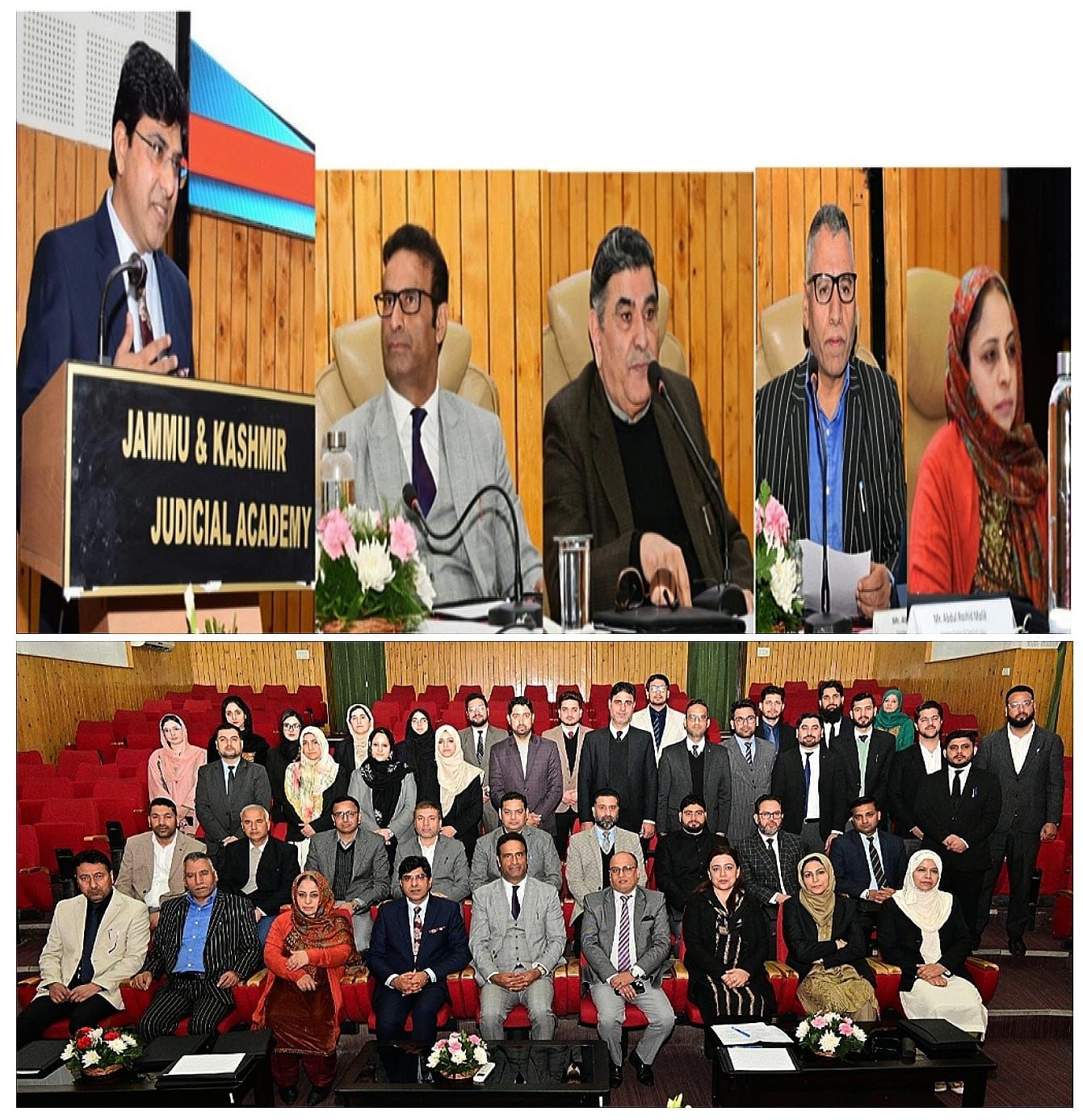
Under the patronage of Mr. Justice Arun Palli, Chief Justice, High Court of Jammu & Kashmir and Ladakh (Patron-in-Chief, J&K Judicial Academy), and under the guidance of the Chairperson and Members of the Governing Committee of the J&K Judicial Academy, a one-day training programme on “Role and Responsibilities of Trial Judges in Ensuring Just, Fair and Speedy Trial (as guaranteed under Article 21 of the Constitution of India)” was successfully conducted today at the Jammu & Kashmir Judicial Academy, Mominabad, Srinagar, for Judicial Officers of the Kashmir Province.
Justice Shahzad Azeem, Judge, High Court of J&K and Ladakh, in his inaugural address, highlighted the pivotal role of trial courts in the justice delivery system, observing that they serve as the first point of interaction between citizens and the judiciary, where facts are established, evidence is tested, and rights are ultimately adjudicated.
His Lordship emphasized that while the maxim “justice delayed is justice denied” remains significant, equal caution must be exercised to ensure that “justice hurried is justice buried.”
He stressed that the real challenge before trial judges lies in maintaining a delicate balance between expedition and fairness. Describing the role of judicial officers as a “sacred trusteeship,” His Lordship called upon them to act as reformers by embracing technology, minimizing delays, and upholding the principles of fairness, efficiency, and human dignity in the administration of justice.
Mr. Naseer Ahmad Dar, Director, J&K Judicial Academy, in his welcome and introductory address, warmly welcomed the participants and underscored that the theme of the programme lies at the very core of the constitutional guarantee under Article 21 of the Constitution of India. He highlighted that trial courts form the foundation of the justice delivery system and that trial judges play a crucial role in ensuring that the promise of a just, fair, and speedy trial is meaningfully realized in every courtroom.
He further informed that the programme had been specifically designed in light of the guidance of Hon’ble Mr. Justice Rahul Bharti, with particular focus on judicial officers who have joined service without prior practice at the Bar.
The first technical session on “Constitutional Mandate and Foundations (Fair Trial under Article 21 of the Constitution of India)” was delivered by Dr. Syed Asima Refai, Faculty Member, Department of Law, University of Kashmir.
In her address, she traced the historical evolution of the right to a fair trial, emphasizing its deep roots in ancient legal traditions, including Roman, Greek, and various religious legal systems.
She highlighted that the principle of fair trial has long been recognized as a foundational element of justice across civilizations and was later institutionalized through landmark developments such as the Magna Carta, which laid the foundation for limiting arbitrary state power and establishing early human rights protections.
She also discussed the transformative constitutional journey from A.K. Gopalan v. State of Madras to Maneka Gandhi v. Union of India, highlighting how the judiciary expanded the scope of “procedure established by law” to mean a procedure that is just, fair, and reasonable.
The second session, conducted by Mr. Abdul Rashid Malik, Former District & Sessions Judge, High Court of J&K and Ladakh, focused on “Practical Challenges before Trial Courts.”
He deliberated on critical issues such as delays in trials, effective case management, handling adjournments and hostile witnesses, and the use of technology in trial courts. He emphasized the importance of judicial diligence and systematic court management, stressing that judges must carefully examine jurisdiction, applicability of law, and relevant materials before issuing orders.
In the context of criminal trials, he highlighted the necessity of ensuring that charge sheets are complete, all relevant documents and witness statements are available, and that the accused is provided with adequate legal representation. The session offered valuable practical insights into enhancing efficiency while maintaining fairness in trial proceedings.
The third and concluding session was delivered by Hon’ble Mr. Justice B.A. Kirmani, Former Judge, High Court of J&K and Ladakh, on “Judicial Conduct, Ethics and Best Practices.”
His Lordship emphasized that constitutional principles serve as a unifying framework ensuring consistency, objectivity, and integrity in the administration of justice.
He observed that the role of a judge requires a transformation wherein personal identity yields to a judicial persona, thereby upholding institutional dignity and maintaining public confidence in the judiciary. His Lordship further noted that judicial power is not absolute but is exercised within a broader legal and moral framework, where judges function as instruments of justice rather than arbiters of personal will.
He urged judicial officers to look beyond procedural technicalities and appreciate the human dimension underlying every case, recognizing that each matter represents a significant concern for the litigant.
The programme concluded with an interactive session and feedback, wherein participants actively engaged with the resource persons, sharing practical experiences and discussing challenges faced in trial courts. The interaction provided a valuable platform for the exchange of ideas and the identification of effective solutions to further strengthen trial processes. (KNC)