

Srinagar, Aug 7 :
Former Jammu and Kashmir interlocutor Radha Kumar on Friday said the abrogation of Article 370 in August 2019 continues to be a deeply contentious issue in the Union Territory, asserting that the constitutional changes dealt a significant blow to India’s federal structure.
Kumar, who co-chairs the Forum for Human Rights in Jammu and Kashmir, made the remarks after meeting National Conference president Farooq Abdullah and party legislators in Srinagar to submit the Forum’s latest report on the human rights situation in the Union Territory.
She said the delegation also met senior CPI(M) leader M. Y. Tarigami and discussed the findings of the report.
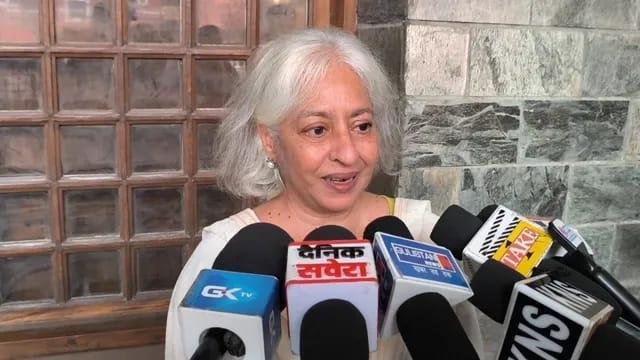
Addressing reporters after the meetings, Kumar said the Forum sought to draw the attention of political leaders to what it described as continuing human rights concerns in Jammu and Kashmir.
“We hope action can be taken at whatever level possible on the human rights violations that are prevalent and ongoing,” she said.
Kumar said the discussions also focused on the constitutional status of Jammu and Kashmir and the larger question of federalism.
According to her, the 2019 decision to revoke the erstwhile state’s special status marked the “first big blow” to India’s federal compact and underscored the need for political parties across the country to jointly safeguard the constitutional rights of states.
She maintained that the issue continues to generate strong public sentiment in Jammu and Kashmir and described the manner in which Article 370 was revoked as unconstitutional.
Referring to the developments surrounding the August 5, 2019 decision, Kumar said thousands of additional security personnel were deployed in the region and over 5,000 mainstream political leaders and workers were detained ahead of the constitutional changes.
She alleged that the move was carried out despite widespread public opposition and argued that it was inconsistent with constitutional provisions relating to the rights of states and the federal framework.
On India-Pakistan relations, Kumar advocated a multi-layered peace process, saying sustainable engagement required dialogue not only between New Delhi and Islamabad but also between the Centre, elected representatives in Jammu and Kashmir, and dissident groups.
She said the peace initiatives pursued during the tenures of former prime ministers Atal Bihari Vajpayee and Manmohan Singh were based on multiple channels of engagement and suggested that a similar approach remained relevant for achieving lasting peace in the region.(KNS).