

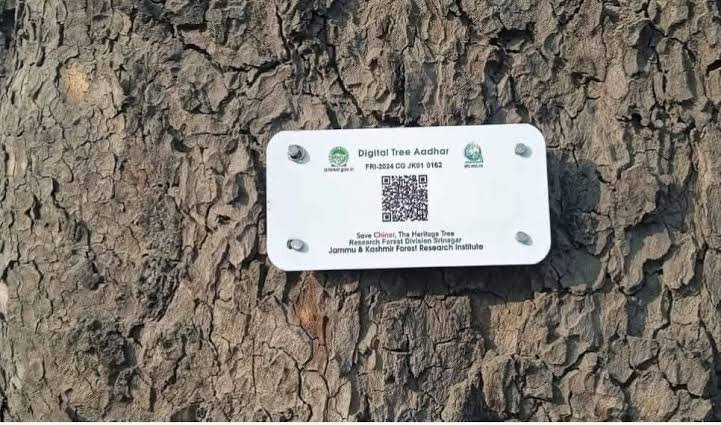
QR-enabled identification plates installed on 13,500 prominent trees as J&K expands efforts to document, preserve its natural heritage
Sajid Raina
Srinagar, Nov 06 :
Jammu and Kashmir has geo-tagged nearly 30,000 Chinar trees and created a digital database to document the iconic species, marking a major step towards digitally recording the region’s natural heritage.
An official told the news agency—Kashmir News Observer (KNO) that the exercise is part of a wider initiative to identify and document prominent trees across the Union Territory, with QR-enabled metal identification plates being installed to make information about individual trees accessible through digital technology.
He said 13,500 such plates have been installed so far, including 10,000 on prominent Chinar trees in Kashmir and another 3,500 on Peepal and Bargad trees in Jammu region.
The official said that the progress was reviewed at a meeting chaired by Forests, Ecology and Environment Minister Altaf Ahmad Wani at the office of the Principal Chief Conservator of Forests and Head of Forest Force in Jammu.
During the meeting, officials informed the minister that geo-tagging of approximately 30,000 Chinar trees had been completed and their details incorporated into a digital database.
The second phase of the initiative will cover the remaining Chinar, Bargad and Peepal trees across Jammu and Kashmir.
The digital documentation is expected to provide a systematic record of the trees, helping authorities identify their locations and maintain information about individual specimens. The QR-enabled plates also introduce a digital identification system for trees that hold ecological, historical and cultural significance.
The Chinar, known for its distinctive broad canopy and changing colours during autumn, occupies a special place in Kashmir’s landscape. Found in public gardens, university campuses, village commons and along roadsides, the trees have remained an integral part of the region’s cultural identity for generations.
Beyond their visual and cultural significance, mature Chinars contribute to the local ecosystem by providing shade, supporting biodiversity and absorbing carbon dioxide.
The initiative also extends to Jammu, where Peepal and Bargad trees are being included in the identification exercise, bringing three prominent tree species under a common documentation programme.
Appreciating the initiative, Wani said the protection of Jammu and Kashmir’s natural heritage was a collective responsibility of the government and the people.
He also directed officials to involve concerned legislators in development works undertaken in their respective districts, saying their participation would help improve transparency and ensure that local realities were taken into account.
The meeting was attended by Commissioner Secretary, Forest, Ecology and Environment, Sheetal Nanda; Principal Chief Conservator of Forests and Head of Forest Force, Sarvesh Rai; Chairman, PCC, Vasu Yadav; Chief Wildlife Warden and Director, Jammu and Kashmir Forest Research Institute, Dr Suneesh Buxy, besides regional wildlife wardens, divisional forest officers and other senior officials.
With the second phase planned, the department aims to expand the digital documentation exercise to cover more of Jammu and Kashmir’s prominent trees—(KNO)