

Sheikh Imran Accuses Mehbooba of Defaming Kashmiris, Rejects AI Claim on Viral Video by PDP Leaders
Srinagar, July 27:
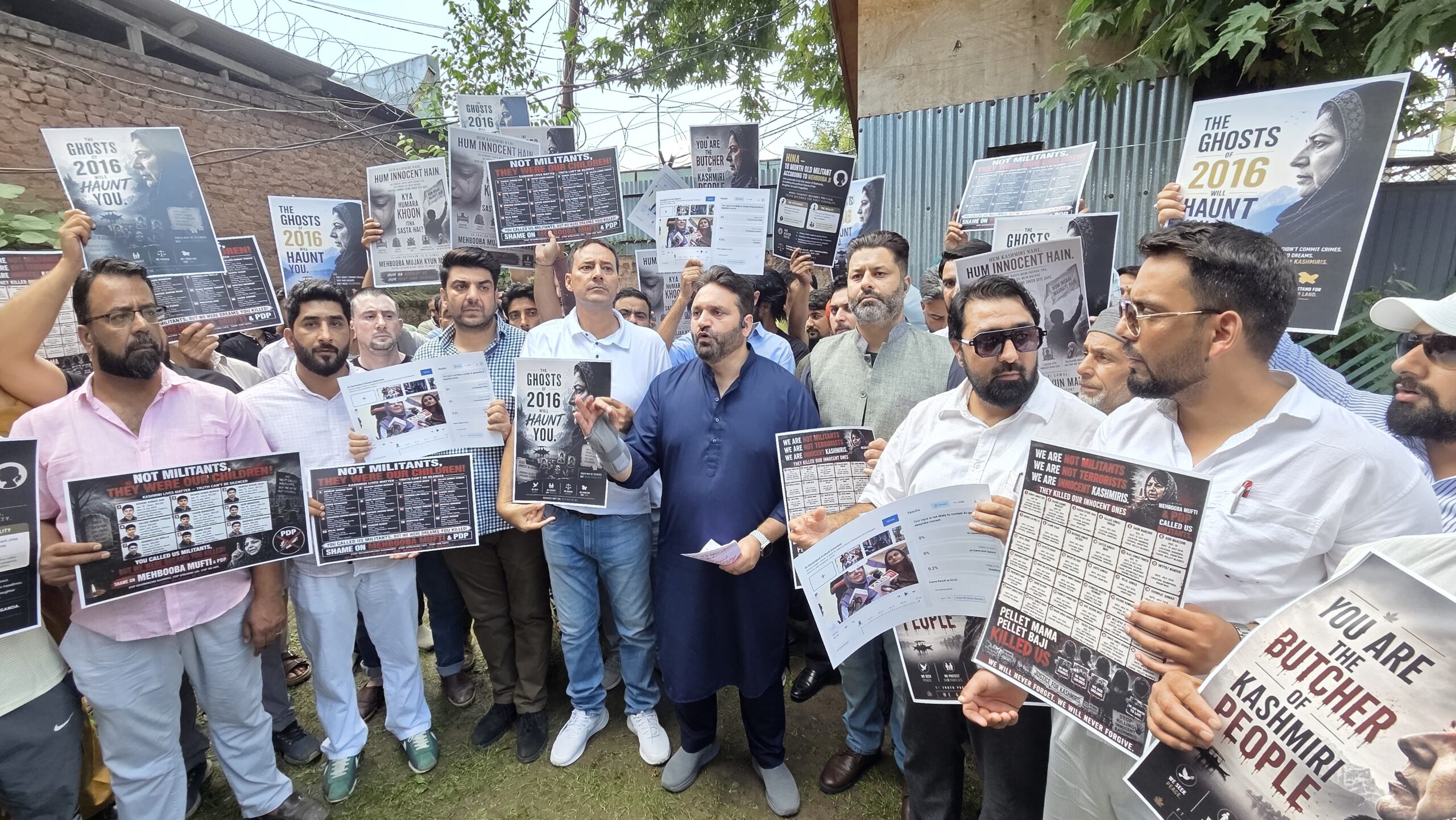
Jammu and Kashmir Peoples Conference on Monday staged a peaceful protest and addressed a press conference at its party office in Jawahar Nagar, Srinagar, strongly objecting to remarks made by PDP President Mehbooba Mufti in Delhi, in which Kashmiris were described as “Militants.”
Addressing the gathering, JKPC State Secretary Organisation Sheikh Mohammad Imran said the party would not remain silent over what he termed an insult to the dignity, identity and reputation of the people of Kashmir. Demanding an unconditional apology from Mehbooba Mufti, he warned that the party would intensify its protest if she failed to withdraw the alleged remarks.
“Mehbooba Ji, apologise to the people of Kashmir. If you do not apologise, today we are inside the party office, tomorrow we will be on the streets,” Imran said.
Launching a blistering attack on the PDP leadership, Imran accused Mehbooba Mufti of attempting to portray herself as a defender of Kashmiris despite, according to him, being responsible for some of the Valley’s most controversial decisions.
“Today in Delhi, Mehbooba Mufti is calling Kashmiris militants. During her tenure, bloodshed took place, pellet guns were used and thousands of our youth suffered. Those who suffered cannot now be branded as militants,” he said.
Referring to the 2016 unrest, Imran said that PDP government oversaw the extensive use of pellet guns, claiming that over 13 lakh pellets were fired, while Mehbooba Mufti herself had acknowledged in the Assembly that around 7,000 pellet cartridges were used.
He further alleged that thousands of people were detained and booked under the Public Safety Act, arguing that the same leadership now demanding the release of political prisoners was responsible for filling the jails.
“You and your father filled these jails. Today you speak about releasing political prisoners, but it was your government that imprisoned thousands,” he asserted.
The JKPC leader also linked PDP to several historic tragedies in Jammu and Kashmir, alleging that the party’s founder, Mufti Mohammad Sayeed, introduced AFSPA in the region and accusing the PDP leadership of failing to protect civilians during incidents including Gaw Kadal, Hawal, Bijbehara and Handwara. He further alleged that the practice of demolishing residential houses began during Mufti Mohammad Sayeed’s tenure.
Imran also rejected PDP’s claim that the controversial video circulating on social media was AI-generated, asserting that the recording had been subjected to technical and forensic verification.
“This is an authentic video. We have verified every nanosecond of every sound bite and conducted a technical examination. How much will you lie?” he said.
He also criticised PDP leaders Waheed ur Rehman Parra and Mohammad Khurshid Alam for questioning the video’s authenticity and claimed the party was attempting to mislead the public instead of addressing the substance of the controversy.
Targeting both PDP and National Conference, Imran alleged that the two parties alternated political roles while pursuing the same agenda.
“National Conference and PDP are Delhi’s two children. One becomes the cop and the other the robber and then they exchange roles. Today, Mehbooba Ji has started playing the cop,” he remarked.
Questioning the alleged characterisation of Kashmiris as militants, Imran asked whether women, children and civilians killed during different phases of the conflict could also be described in that manner.
“Was the five year old girl a militant? Was the 18 month old child a militant? Were those killed in Bijbehara, Handwara and on the funeral procession of Mirwaiz Molvi Farooq militants?” he asked.
Reiterating that Kashmiris are law abiding citizens deserving of dignity and respect, Imran said the People’s Conference would continue its campaign until Mehbooba Mufti issued what he described as a clear and unconditional apology to the people of Jammu and Kashmir.
He maintained that the party’s protest was aimed at defending the honour and collective identity of Kashmiris against what it called an unacceptable and defamatory characterisation.