


Latief U Zaman Deva
The spectacular contribution of Mahraja Gulab Singh lay in creation and consolidation of the erstwhile State of J&K notwithstanding its replete & deep diversities which, after the termination of the British rule in 1947,initially checkmated successfully the vision of Sheikh Mohammed Abdullah for the position of the State in the Union of India akin to one once enjoyed by Ukraine & Belorussia in Soviet Union before its disintegration in 1990. One can arrive at a prudent conclusion in this behalf on acquainting oneself with the parleys between him and union Govtt about application of laws to the State . He didn’t even consent to the application and extension of a few laws on entries falling in union list and corresponding with subjects covered in the Instrument of Accession. This legacy continues to haunt & blunt the political aspirations of the centrifugal conglomerate sweeping over an absolute majority of people cutting across regional, ethnic & linguistic diversities & therefore a framework operable to the advantage of the centripetal political and the Central Executive formations under the subterfuge of Constitution, democracy & the rule of law. Under these circumstances the “Apple cart” suits national interests.
Quadrification
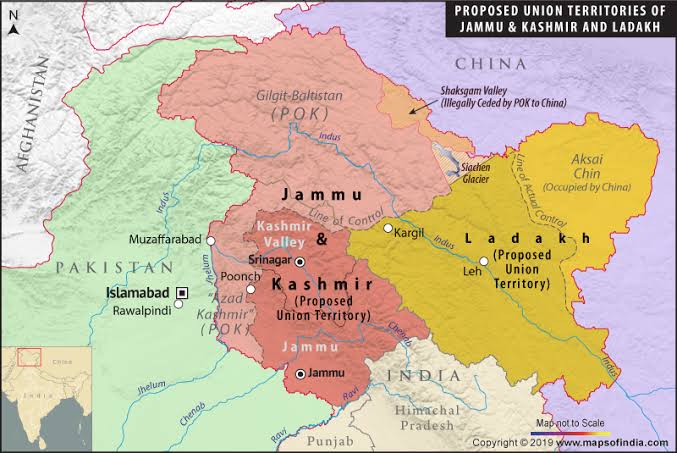
Confront the Votaries of “Division “ for logic in support of their chauvinistic orchestration their stalk arguments move around “ nothingness in common with Koshur & Kashmir “ but a swift retort about the application of their logic to “ Chenab Valley and Peer Panchal” regions infuriates them to the extent of denying intra-divisional stark diversities springing from the factual & ground positions. In Ladakh barring majority of Buddhists none from other communities had ever harboured the idea of seceding from the J&K till social & commercial boycott launched against them by the Buddhist Association from 1989 to 1995. This got manifested immediately after August 5, 2019 when an endless wave of protests gripped Kargil Distt & disappointment writ large on the faces of common people other than Buddhists in Leh Distt. Disregarding public sentiments by forcing misconceived decisions breads contempt & propels urges in disillusioned people for alternatives unless democratic options such as conduct of referendum are adopted. Buddhists were themselves demanding UT status only but in order to carry along others with them as well who represent 52% of the population of the region against 48% of the Buddhists ; the Leh Apex Body has now included in their Charter of demands Statehood also & thus unifying all sections of the Society. Chenab Valley & Peer Panchal have distinct identities & have subjugated their yearnings, for territory based Institutional framework, due to being constituent units of the erstwhile state of Jammu & Kashmir. A referendum may be the best option for ascertaining the public perspective & in the event of its holding the majority of people in these two regions may prefer the existing position or in alternate an empowered UT status with Assemblies triggering vivisection of the J&K reducing Dugger Elaka to a narrow loop between Lakhanpur & Patnitop Hill range. A gigantic disservice to the legacy of Gulab Singh. No dispensation regardless of its ideology can foster uncertainty and dissatisfaction in inhabitants of the border areas which lesson Modi Govtt also learned when relentless agitation by the farmers from Punjab and adjacent regions forced PM to scrap farm laws. Ladakh & Peer Panchal scenario present a similar dilemma. Chenab Valley also for reasons of high & mighty mountaineous ranges coupled with indigenous political aspirations of the majority of people contrary to one espoused by a parochial section of the society.
Regional identities
UT of J&K consists of four natural regions which are detailed below:-
1) Sub- mountain & semi- mountainous loop comprising of Kathua, Samba, Jammu & Udhampur Distts measuring 8385 Sq kms + Reasi sub Division,
2) Chenab valley ( outer Hills) with Doda, Kishtwar & Ramban Distts falling in it & spread over 11885 Sq Kms +Mahore & Dharmadi sub-Divisions of Reasi Distt,
3) Peer Panchal ( Jhelum basin ) having within it the Distts of Rajouri & Poonch covering 4034 Sq kms + tiny contiguous areas of Reasi Distt &
4) Kashmir Valley ( Jehlum Valley) formed on 15948 Sq kms, as a homogenous entity in general with recorded history of 5000 years and anthropologic traces/ presence of 7000 years.
In region ist including Sub Divisions of Dharmadi & Mahore the Dogras constitute 79.38% , Gujjar 6.51% , Koshur 5.79% ,Punjabi 5.11% & Pahari 2.55% . The entire loop falls in sub- tropical Zone except Lohi Malhar areas in Kathua bordering Bhaderwah Distt Doda & sub-Divisions of Mahore & Dharmadi otherwise falling in Outer Hills region. The 2nd region is temperate with 65.74 % Koshur population, 11.24% Gujjar, 5.56% Dogra 4.45% Pahari. The 3rd region of Peer Panchal formed by the two Distts of Rajouri & Poonch has 56.10% Paharis,, 38.46% Gujjar, 3.78 Koshur & 1. 07% Dogra population. This region is partly temperate & partly sub-tropical.
Total diversity galore in all aspects including Geography, Geology, Linguistics, ethnicity , political aspirations, culture and civilizational moorings & places of origin, before migration and Settlement at present habitats. There is need for promoting the ethnic cum linguistic identify of the four regions by acknowledging Jammu as Elaka Dugger, adoption of Chenab as identity for the three Distts & two sub Divisions of Reasi Distt, locally already nomenclature of Chenab valley in use & the Peer Panchal range the best description for the twin border Distts where identify crisis of the two largest ethnic communities calls for affirmative action moreso in face of the envious political positions occupied by the two major communities trans Jhelum in Pakistan Administered Kashmir (PAK) . The present exclusive Competing discourse confined to Koshur & Dogras ignites resentment against non availability of space in the dialogue for the inhabitants of two border Distts on line of Actual control and hapless residents sandwiched between middle Himalayas & lower Shiwaliks (Chenab Valley) .
Reorganisation of the Divisions
Recognition and acknowledgement of the regional identities should be accompanied by reorganisation of Divisional set up which would transform identities into territorial bastions based on ethnicity & languages. The reorganisation of States on linguistic basis in 1956 may have led to creation of Punjab State per se Punjabi Sikhs & Telugu State ( Andhra Pradesh) by amalgamation with Hyderabad of the adjacent non Tamil areas from Madras Presidency & exclusion of non- Telugu regions from Hyderabad in Mysore,now Karnataka. Actually Punjabi people particularly Sikhs haven’t reconciled with the two Divisions of Punjab, ist in 1947 & 2nd in 1956. The quest for unity in diversity instead of trifurcation post independence could have addressed the concerns of Punjabi in the background of pristine image of Sikh empire & inevitability of remaining on board with Haryanaites & Himachali.
. After partition there used to be two Governors for a population of 32 Lakhs( 1941 Census) ,one each for Kashmir and Jammu. The nomenclature of the Divisional head was rechristened to Commissioner in 1950s & in 1963 as Divisional Commissioner. Based on the census 2011 the population of J&K was 12.27 Million & the State Decadal Growth Spurt ( 2001-2011) @ 23.64%. Accordingly the projected population ending 2025 in the UT of J&K is 16.5 Million & job profile of the Divisional commissioner has increased manifold from just Revenue and the Law & Order duties. Himachal Pradesh resembles J&K in many respects but has three Divisions for population of over 6 Million (2011) spread over 55673 Sq kms. In PAK there are three Divisions (Mirpur,Poonch & Muzaffarabad) and ten Distts for population of 40.5 lakhs (2017) covering 13297 Sq Kms and in Gilgit Baltistan three Divisions ( Gilgit, Baltistan, Diamir) comprising fourteen Distts covering an area of 72971 Sq kms for population of 15 Lakhs (2017). The new Divisions apart from four natural regions may have to reckon with Maraz ( South kashmir) & Kamraz ( north Kashmir) for the reasons of population & historical context of Kashmir valley at one stage was an embodiment of Kamraz, Yamraz & Maraz entities. The region of Elaka Dugger on the basis of population, massive industrialisation post Indra-Abdullah Accord 1975 , undeclared capital for central Deptts & other Organizations should have two Divisions, Jammu & Udhampur. The break up could be as follows:-
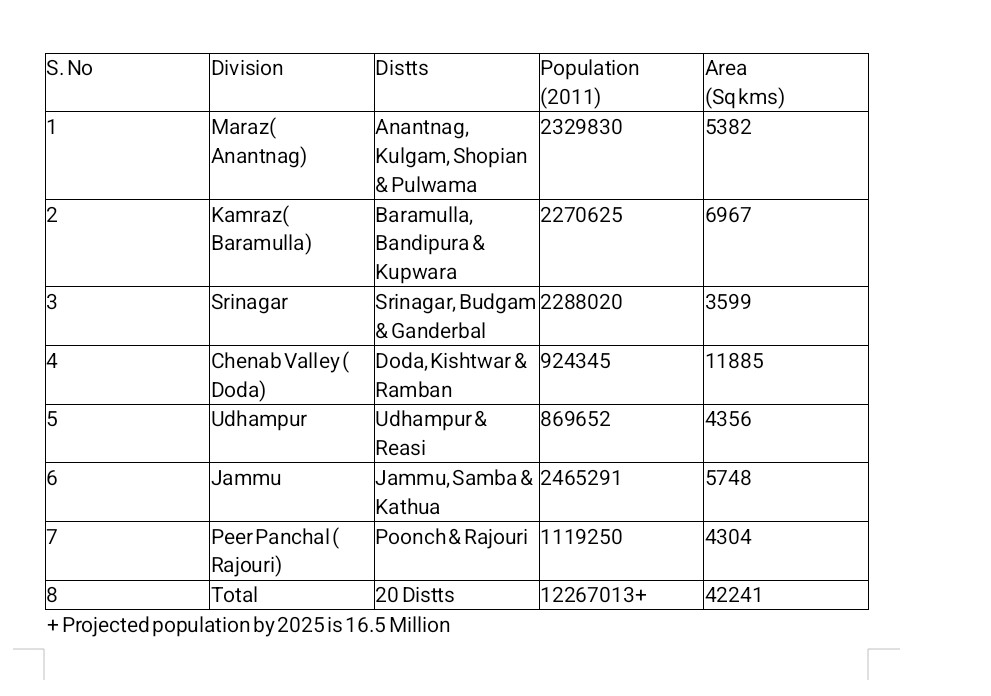
- Projected population by 2025 is 16.5 Million
The union territory of Ladakh extends over 59146 Sq Kms with population of 2.74 Lakhs ( 2011) and has 2+5=7 Distts with 01 Division. Initially on the eve of the creation of a Division for Ladakh in the erstwhile State the locations of Divisional offices were apportioned between Leh & Kargil. After split of the State into two union territories by down grading the State of J&K there is every justification for a full Divisional status for Kargil comprising of Distts of Kargil, Drass & Zanaskar.
There is no need for constituting a Commission and instead the Council of Ministers under CM could take decision on the basis of Election Manifest of the ruling party for rationalization & creation of new Divisions. The momentous decision need be followed by constituting a committee of senior officers under chairmanship of the Financial Commissioner Revenue for a) determining the composition and size of the offices of Divisional heads in contrast to the existing compositions due to considerable reduction in the size & territorial jurisdictions b) identification of sites for office complexes & other infrastructure and logistics c) interim office arrangements , d) identification of surplus staff for redeployment & redesignation of posts with objective of minimising fresh creations & inter alia to take a call on utilisation of twenty posts of ADDCs whose existing job assignments could be entrusted with two Distt Offices of the Planning and Development Deptt , the Appellate & Revisional powers of the Divisional Commissioners to be substantially shared with the Regional Directors Survey & Land Records & Combination of Regional Directorates under principal Deptts like Health, Agriculture and Horticulture, Industries, Handicrafts & Handloom, Tourism,Floricultured & Hospitality and Protocol etc e) working out one time financial requirement & its phasing for construction of five modern office complexes in the local ambience laden architecture and earth quack resistant structural designs & f) examining suggestions / pleas for inclusion and exclusion of contiguous areas while determining the territorial boundaries of the Divisions.
Under J&K Reorganisation Act 2019 the power to create new administration Units fall within the jurisdiction of the Lf Governor. The Interregnum period,between declaration of the Govtt forward move & the notifying of the new Divisions formally, may last for more than one year which is sufficient duration for raising public opinion without any acrimony in favour of an epoch making development whose spin off shall go beyond public services but simultaneously may prove to be a stepping stone for broader unity in J&K. Hence a real tribute to Mahraja Gulab Singh by J&K NC.
Policy interventions / Decisions
1) The bogey of inter Divisional development disparities & creation of infrastructure is by now imaginary only. After identification of the sectors falling in the category of disparities between the two Divisions by the Skiri Commission in its report during 1980; the mechanism put in place by the Govtt brought it down completely to the extent permissible & by 2000 Jammu had overtaken Srinagar as disclosed in the Report of the Committee headed by Madh Godbolay, former Home Secretary GOI. The impact factor of largesse extended by the Centre to the State/UT or used by itself directly depicts on the basis of financial and physical indices that the dice is heavily loaded in favour of Jammu due to geographical factors. Need based approach should be mantra for development of the UT cutting across Villages, Panchayats, Blocks, Municipal Bodies in urban areas, Distts & its sustenance through statutory safeguards ;
II) In the report of the maiden State Finance Commission headed by Mehmood U Rehman IAS (Retd) ,while adopting Distt as unit of planning and development on the basis of three tyre model in the rest of the Country ,Distts facing disparities have been identified. To rectify them within a time frame for balanced development and growth the Govtt should come out with a sustainable financial package for execution through a separate window in the Planning and Development Deptt. J&K should also have a UT level Balanced Development Board( BDB) consisting of upto twenty members who could be drawn from local reputed Economists, Specialists in urban & rural Development, Environmentalists, Legislators and those adept & fully conversant about the status and degree of transformation undergone by marginalised sections of the Society. BDB shall advise the Deptts on strategy and other policy initiatives for balanced development of all twenty Distts and two Capital Cities and also to supervise & monitor the actual execution for corrective measures through interventions wherever warranted.
iii) Lt Governor must be credited for introducing fully three tyre Panchayat Raj in J&K but the legal framework under J&K Panchayat Raj Act suffers from two major shortcomings which should be addressed before setting in motion the process for elections for Panchayat Raj Institutions and Municipal bodies. The uniformity in the number of members for DDCs irrespective of the population is antithetical to electoral system and presently Distts with 2 to 3 lakh population have number of councillors equivalent to Distts having population above one million. Population slabs need be laid down fixing thereunder the minimum & maximum number of members the DDCs could have by reference to the population & within the applicable slab & entitlement to the number of members the electoral constituencies carved out in each Distt. The statutory DDCs could replace the Distt Development Boards provided representation is provided to the 27% urban population in these Councils by earmarking constituencies on the principles applicable to rural constituencies with requisite modifications as may be specified in each delimitation process of DDC constituencies. The existing ex-officio dispensation about membership of Mayors, Presidents and Chairpersons of the urban Institutions in the DDCs isn’t representation to the people but to specified individuals which ought to be reversed & made democratic by electing members directly or through electoral college comprising of the councillors of the Urban Institutions;
iv) Enactment of Private Universities Law is long overdue & pending consideration for long before the UT Govtt. Thousands of students from JK move out for studies in rest of the Country due to availability of scholarships under PMs Special Scheme , availability of varied discipline choices , residential character of the universities & vibrant campuses and this entails Crores of ₹ which can be retained & invested in JK provided new Universities are opened both in private & public sectors subject to stringent measures put in place for ensuring compliance with UGC & UT Higher Education laid down conditions. In Govtt sector and in accordance with Election Manifesto of the NC two campuses of each of the University of Jammu and University of Kashmir to be upgraded into full-fledged & independent universities on self financing mode with periodic liberal assistance from the UT Govtt during initial years till full fruition of the vision. Islamic University of Science and Technology Awantipur Distt Pulwama & BG Shah Padshah Islamic University Rajouri are two successful examples
The South & North campuses of Kashmir University & Bhaderwah & Udhampur Or Kathua campuses of Jammu university merit upgradation. The focus should be on employability of the programmes to be added based on assessment of job markets around the world. Govtt should accord priority for Technology led & skill based universities in the private Sector and established outside the two capital cities /concerned Distts;
v) With a view to promoting the mother tongues prevalent in J&K the setting up of separate Academies for Koshur, Dogri, Gujri, Pahari & Punjabi is called for & percentage of each of five language speakers within the UT a reckonable factor in budgetary allocations. In accordance with the mother tongues Census 2011 Koshur speakers are 56 %,Dogri 21%,Gujri & Pahari 10% each & Punjabi 1.87%. Koshur Academy in Srinagar & its camp offices in Doda & Jammu, Dogri Academy in Jammu,Gujjri in Poonch ,Pahari in Rajouri & Punjabi in Jammu. The J&K Academy for Art, Culture, and Languages should be charged with for Art and culture and State official languages i-e Urdu, Hindi & English;
vi) The J&KAS has become unwieldy & high time to decadre such services as should be manned by specialists like Information, Industries, Handicrafts & Handlooms, Project Officers under ICDS, Tourism and Hospitality & Protocol, Stationery & Printing etc etc. Out of remaining core services to Constitute JKAS & others as allied services. This shall also pave the way for equal opportunities as under the existing system the specialists don’t generally participate in the recruitment processes &
vii) Socio- economic caste Survey undertaken for identifying castes/ groups in sub- tropical & temperate regions from STs & SCs who have partaken benefits of reservations far below to the otherwise share commensurate to their populations due to extreme educational and economic backwardness qualifying for sub categories within the category concerned. Towards alignment of reservations in J&K with national level position Castes found backwards on the basis of Eleven point criterion adopted by the Mandal commission, subject to modifications & additions respectively about housing and adverse impact of militancy on non- combatants in JK context, shall be notified subsuming all under one category of “Backward classes” ending RBA & LOC/ IB categories.
The author is IAS (Retd) & former Chairman of J&K Public services Commission & can be reached on aaluzdeva_221256@ymail.com