

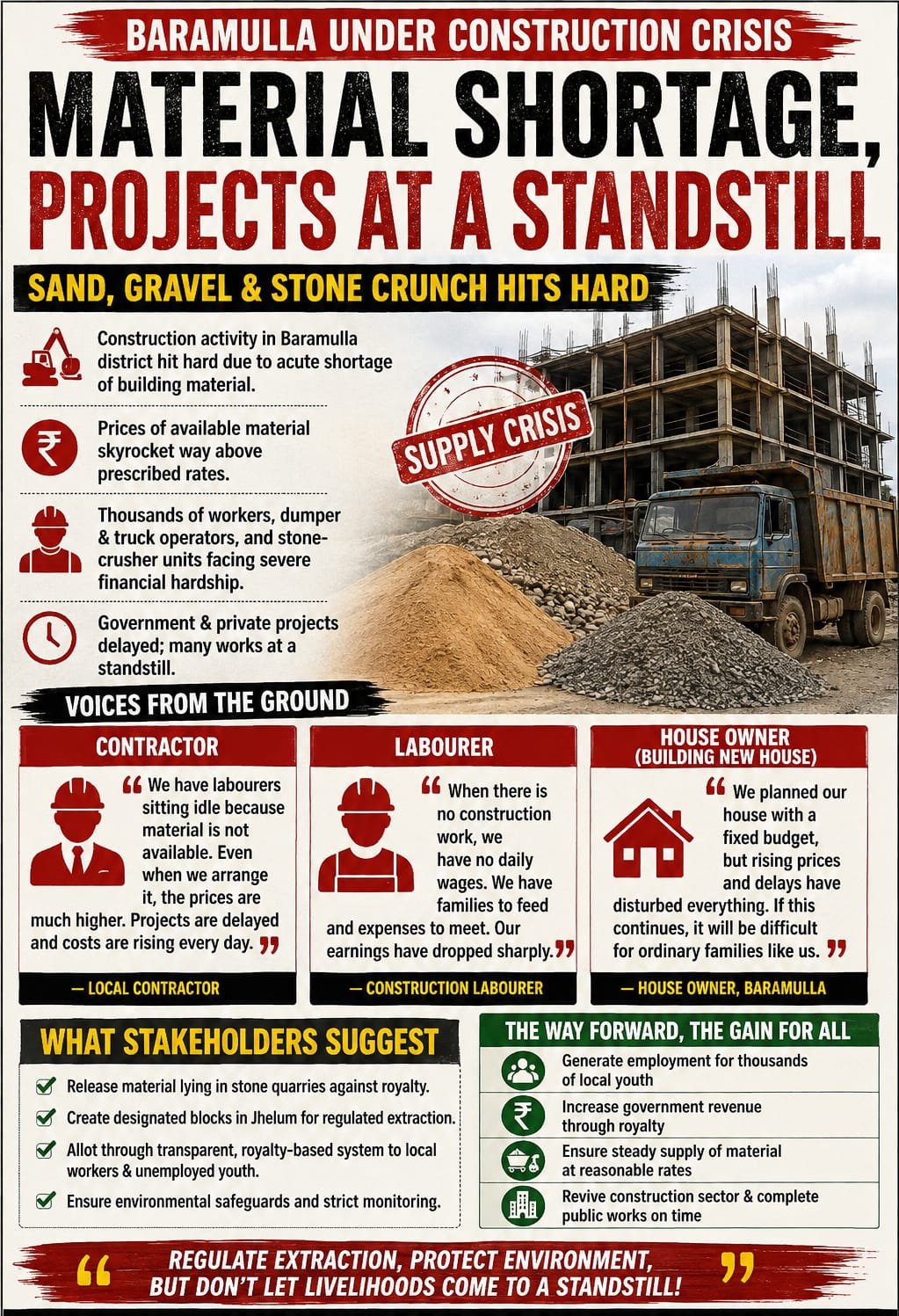
Sand, gravel and stone supply disrupted; contractors, labourers, transporters and house owners count mounting losses
Inayat Qayoom
BARAMULLA, AUGUST ,11 :
A severe shortage of construction material has brought large parts of Baramulla’s construction sector to a grinding slowdown, leaving scores of private projects stalled, public works facing delays and thousands of workers and transporters staring at an uncertain income.
From new houses and shopping complexes to government infrastructure projects, the shortage of sand, gravel and stone is being felt across the district. Contractors and consumers claim that even when material becomes available, it often comes at prices significantly higher than the prescribed or prevailing rates, pushing construction costs sharply upward.
The crisis has exposed a widening gap between restrictions imposed to curb illegal extraction and the availability of a legitimate supply chain for genuine construction requirements.
Contractors say the shortage is creating a domino effect across the entire construction economy.
“The biggest problem is uncertainty. We do not know when material will be available or at what price. Labourers arrive at the site, but without sand, gravel or stone, there is nothing they can do. Projects are getting delayed and our commitments to customers and departments are becoming difficult to honour,” said a local contractor.
According to contractors, every day of delay adds to the cost of construction through labour payments, machinery rentals, transportation expenses and other overheads.
For construction workers, the material shortage has translated directly into lost working days.
“Our income depends on daily work. When construction stops, our earnings stop. We have families, school-going children and household expenses. We cannot survive for long if sites remain closed,” said a labourer working on residential construction in Baramulla.
The slowdown is also affecting masons, helpers, electricians, plumbers and other workers whose employment depends on construction sites progressing according to schedule.
For families building their first homes, the crisis has become a financial headache.
A house owner Nazir Ahmad who is currently undertaking construction said the project had already exceeded the original financial calculations.
“We planned the house according to our savings and loan arrangements. But when material is unavailable or prices suddenly increase, the entire budget gets disturbed. A delay also means paying labourers and other expenses for a longer period. Ordinary families cannot absorb such additional costs indefinitely,” he said.
The situation is equally worrying for people investing in commercial properties.
A person constructing a shopping complex said every month of delay represents blocked investment.
“Our money is already invested in the project, but construction cannot move forward without a continuous supply of material. The longer the project remains incomplete, the greater the financial burden. It also delays the opening of shops and the employment opportunities they could generate,” he said.
The impact has travelled beyond construction sites.
Dumper and truck operators who depend on the movement of sand, stone and gravel are reportedly facing a sharp decline in business. Many vehicle owners have financed their vehicles through bank loans and continue to bear monthly instalments even when their vehicles remain idle.
“The vehicle loan instalment does not stop because construction has stopped. Fuel, maintenance and other expenses are also there. If there are no trips, there is no income to meet these liabilities,” a dumper operator Bashir Ahmed said.
Stone-crusher operators and workers associated with material processing are also among those reporting financial losses.
The government’s efforts to curb illegal mining and protect the Jhelum and other natural resources have received support from environmentally conscious residents. However, stakeholders argue that restrictions must be accompanied by a transparent and legally compliant alternative supply mechanism.
They question how legitimate construction demand is expected to be met if extraction is restricted without ensuring adequate material through authorised channels.
“Nobody is asking for uncontrolled mining. What people are asking for is a legal, monitored and environmentally responsible supply system. If extraction has to be restricted, the administration must simultaneously create an alternative source for genuine construction requirements,” said a social activist Afaq Bhat local stakeholder.
One proposal gaining support among stakeholders is the regulated release of construction material already extracted and lying in authorised quarries, subject to verification, environmental compliance and payment of applicable royalty and government dues.
Stakeholders have also suggested identifying scientifically assessed and environmentally permissible zones for controlled extraction, with strict monitoring of quantities, transportation and compliance.
They argue that a transparent royalty-based mechanism could bring several benefits simultaneously employment for local workers and unemployed youth, additional government revenue, regulated extraction and a predictable supply of construction material.
The issue, stakeholders say, is no longer confined to the construction industry.
A prolonged slowdown could affect masons, labourers, drivers, machinery operators, building-material suppliers, hardware shops, contractors and a range of small businesses dependent on construction activity.
Government projects could also face delays if departments are unable to secure material within stipulated timelines, potentially leading to cost escalation and delayed delivery of public infrastructure.
Stakeholders are therefore demanding that the administration convene an urgent meeting involving contractors, labour representatives, transporters, crusher operators, house owners and concerned departments to assess the actual demand-supply gap and formulate a workable mechanism.
The emerging demand from the ground is not for unrestricted extraction. It is for regulation instead of disruption.
Stakeholders say environmental safeguards, scientific assessment, royalty collection, digital monitoring and strict enforcement against illegal mining can coexist with a legal supply system.
For the labourer waiting for his next day’s wage, the contractor struggling to complete a project, the transporter paying a monthly bank instalment and the family waiting to move into its unfinished house, the issue is immediate.
Baramulla’s construction sector is waiting for material and for a policy response that can protect both the environment and the livelihoods dependent on the industry.